
Messier 107 (M107) – Crucifix Cluster
April 15, 2023
Use mouse wheel to zoom, drag to pan, and buttons for other options
Although discovered much earlier, Admiral William Henry Smyth of the Royal Navy—an avid amateur astronomer in his retirement—observed Messier 107 (M107) in 1837 and remarked that five bright stars he could see in the cluster were arranged in the pattern of a Crucifix—hence it’s colloquial name, the Crucifix Cluster.
Although Charles Messier’s partner Pierre Méchain discovered it in 1782, and William Herscel independently discovered it a year later, it wasn’t added to the Messier Catalogue until 1947 by Helen Sawyer Hogg.
With an age of 13.95 billion years, M107 is one of the oldest globular clusters known.
Globular clusters are ancient collections of stars that are gravitationally bound together in a spheroidal shape. Some are almost as old as the universe itself. They can contain anywhere from tens of thousands of stars to millions of stars. The stars they house tend to be very old as well, because star formation inside the cluster has largely ceased. The formation of globular clusters is not well understood. Current research leans toward the idea that they formed from very dense molecular clouds in the early universe. Some larger globular clusters may once have been dwarf galaxies whose larger star populations were stripped away from the core by larger galaxies.
M107 Facts
Distance: 20,000 light years
Number of stars: 100,000
Diameter: 79 light years
Age: 13.95 billion years




Telescope

Celestron 1100 EdgeHD
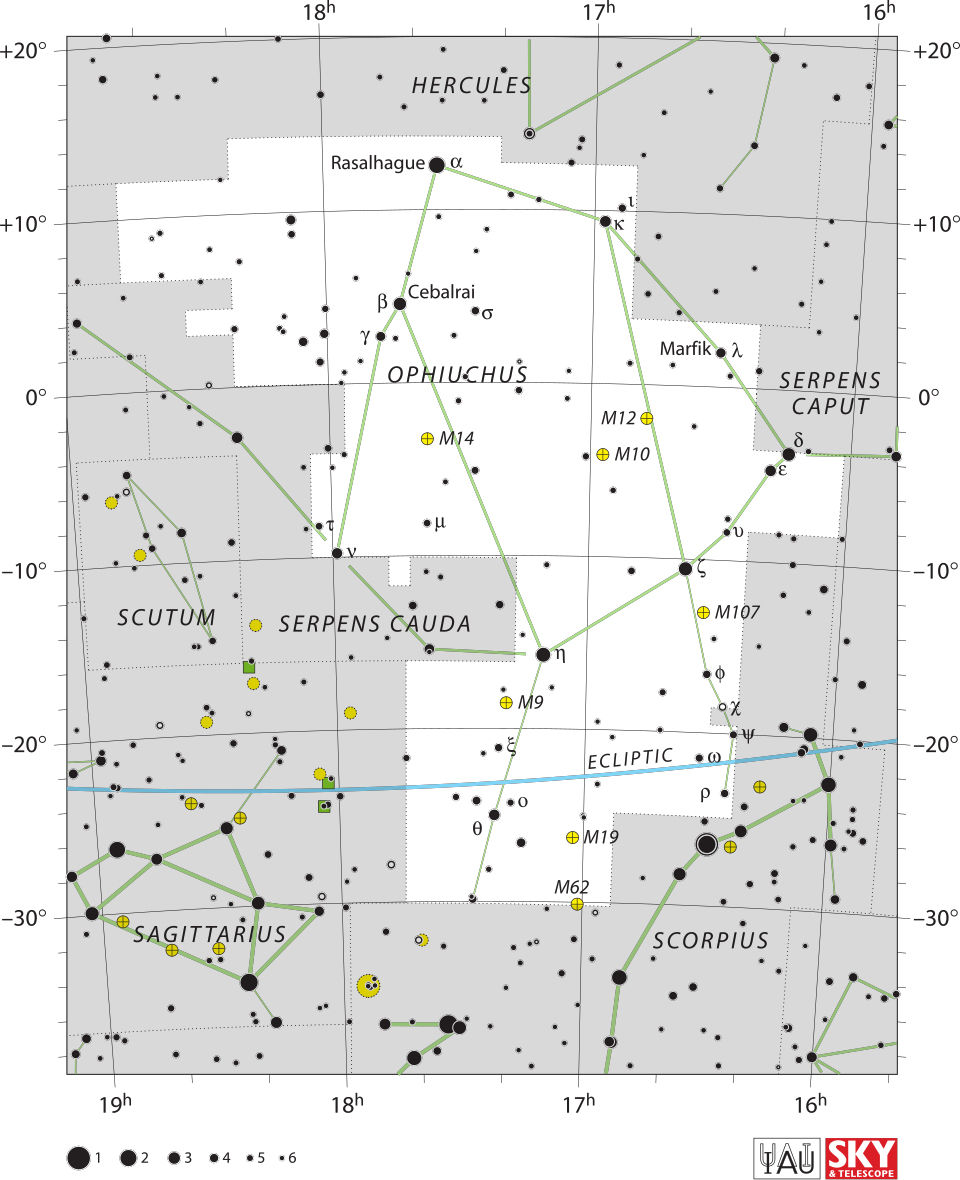
Finding Chart

Click to expand
Image Capture
Location:
Back yard in North Dallas
Camera:
Total integration: 5h 32m
Integration per filter:
- Lum: 2h 20m (140 × 60")
- R: 1h 4m (64 × 60")
- G: 1h 4m (64 × 60")
- B: 1h 4m (64 × 60")
Coordinates: 16h 32m 31s · -13° 3′ 33″
ZWO ASI6200MM-Pro

Awards
