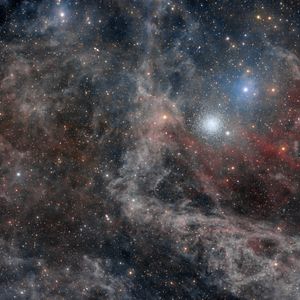
Messier 15 (M15) – The Great Pegasus Cluster
August 9, 2021
Use mouse wheel to zoom, drag to pan, and buttons for other options
Messier 15 (M15) is one of the oldest known globular clusters orbiting our Milky Way galaxy. And it was the first globular cluster (there are still only four) to have a planetary nebula—a gaseous cloud surrounding a dying star—discovered in its midst. It’s location is marked above in the overlay (which you can view by clicking the eye icon) as PK065-27.1, but it’s also known as Pease 1.
M15’s core contains a rare intermediate-mass black hole with a mass approximately four times the mass of our sun. I has a novel stellar population with a large concentration of Cepheid variable stars at around 112, and it also contains nine pulsars as well as a binary neutron-star system.
Globular clusters are ancient collections of stars that are gravitationally bound together in a spheroidal shape. Some are almost as old as the universe itself. They can contain anywhere from tens of thousands of stars to millions of stars. The stars they house tend to be very old as well, because star formation inside the cluster has largely ceased. The formation of globular clusters is not well understood. Current research leans toward the idea that they formed from very dense molecular clouds in the early universe. Some larger globular clusters may once have been dwarf galaxies whose larger star populations were stripped away from the core by larger galaxies.
M15 is the densest globular cluster astronomers have yet found. It has undergone a process called core collapse. This phenomenon occurs when so many stars are packed in such a small space that they start attracting each other gravitationally toward the center of the cluster. Of the 157 globular clusters known to orbit the Milky Way, 21 of them have undergone a core collapse.
M15 Facts
Distance: 35,700 light years
Number of stars: 100,000+
Diameter: 180 light years
Age: 13.7 billion years


Telescope

Celestron 1100 EdgeHD
Finding Chart

Click to expand
Image Capture
Location:
Back yard in North Dallas
Camera:
Total integration: 3h 40m
Integration per filter:
- Optolong L-Pro: 3h 40m (110 × 120")
Coordinates: 21h 29m 58s · +12° 10′ 12″
ZWO ASI2400MC-Pro

Awards