
Messier 19 (M19) – The Oblate Globular Cluster
May 22, 2025
Use mouse wheel to zoom, drag to pan, and buttons for other options
If you’re looking for an oblate globular cluster, Messier 19 (M19) is the mostest oblatest known. Globular clusters are usually spherical, but this one is stretched out—probably because it’s only 6,500 light years from the galactic center with its significant gravitational pull.
Globular clusters are ancient collections of stars ranging in age that are gravitationally bound together in a spheroidal shape. Some are almost as old as the universe itself. They can contain anywhere from tens of thousands of stars to millions of stars. The stars they house tend to be very old as well, because star formation inside the cluster has largely ceased. The formation of globular clusters is not well understood. Current research leans toward the idea that they formed from very dense molecular clouds in the early universe. Some larger globular clusters may once have been dwarf galaxies whose larger star populations were stripped away from the core by larger galaxies.
M19 Facts
Distance: 28,000 light years
Number of stars: 300,000
Diameter: 140 light years
Age: 11.9 billion years




Telescope

Planewave CDK12.5
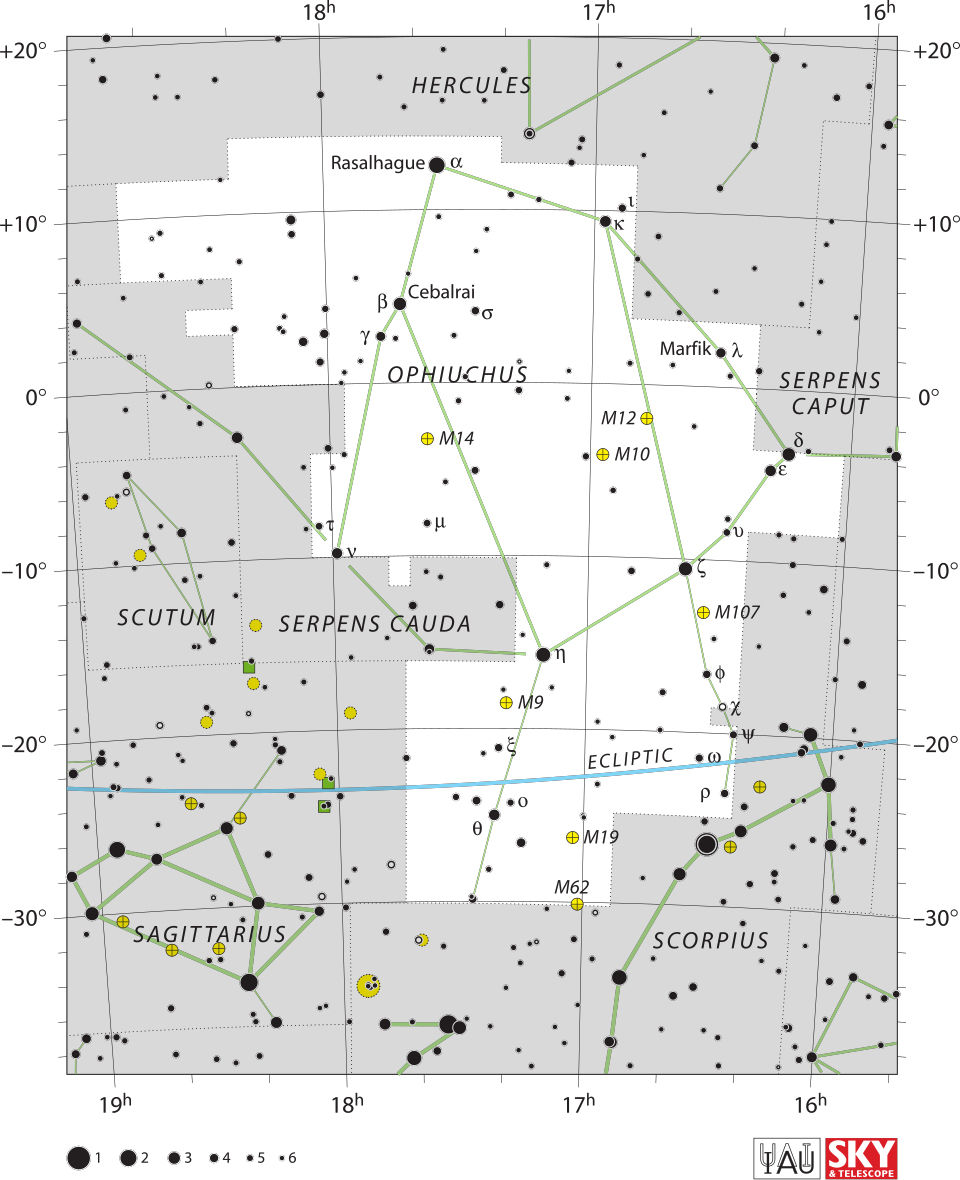
Finding Chart

Click to expand
Image Capture
Location:
Deep Sky West
Camera:
Total integration: 8h 40m
Integration per filter:
- R: 2h 52m (172 × 60")
- G: 2h 54m (174 × 60")
- B: 2h 54m (174 × 60")
Coordinates: 17h 2m 30s · -26° 15′ 55″
Moravian C5a-100M

Awards
