
Messier 10 (M10)
August 10, 2021
Use mouse wheel to zoom, drag to pan, and buttons for other options
At only 15,000 light years away, Messier 10 (M10) is one of the closest globular clusters to Earth (M4 is the closest).
M10 contains a large number of stars called blue stragglers. Blue stragglers are stars in an old cluster that appear brighter and bluer than we would expect given the cluster’s age. Scientists are not sure what causes this, but one prominent theory suggests they are the result of star collisions in a densely packed cluster. While it only contains a handful of Cepheid variables, its core comprises and unusually large population of binary stars—around 14%. Cepheid variables are stars that vary in brightness in a regular, predictable way. This makes it possible for scientists to determine the distance to them.
Globular clusters are ancient. They are many billions of years old—usually 10 to 13 billion years old—almost as old as the universe itself. The stars they contain tend to be very old as well, because star formation inside the cluster has largely ceased. The formation of globular clusters is not well understood. Current research leans toward the idea that they formed from very dense molecular clouds in the early universe. Some larger globular clusters may once have been dwarf galaxies whose larger star populations were stripped away from the core by larger galaxies.
M10 Facts
Distance: 15,000 light years
Number of stars: 100,000
Diameter: 83 light years
Age: 11.4 billion years




Telescope

Celestron 1100 EdgeHD
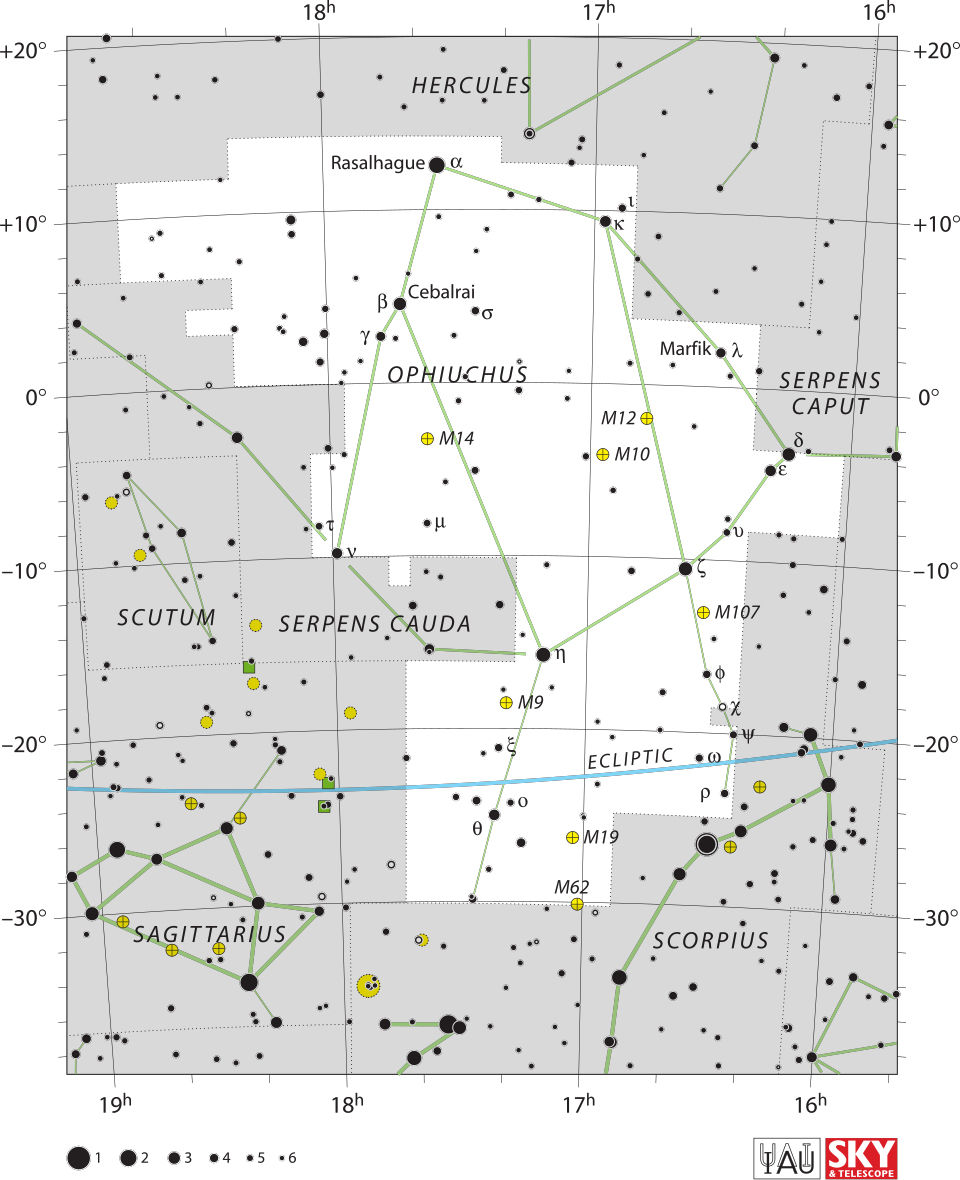
Finding Chart

Click to expand
Image Capture
Location:
Back yard in North Dallas
Camera:
Total integration: 1h 50m
Integration per filter:
- Optolong L-Pro: 1h 50m (55 × 120")
Coordinates: 16h 57m 10s · -4° 5′ 45″
ZWO ASI2400MC-Pro

Awards
