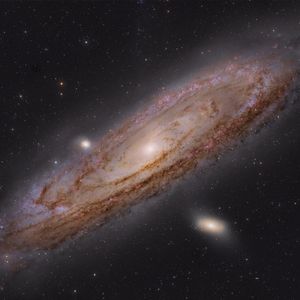
Messier 3 (M31) – The Great Andromeda Galaxy from Big Bend
November 20, 2020
Use mouse wheel to zoom, drag to pan, and buttons for other options
The closest large galaxy to the Earth at a mere 2.6 million light-years away, Messier 31 (M31) has a long, illustrious history with humanity. Visible with the naked eye even under questionable conditions, it’s impossible to know who discovered it first. Persian astronomer Abd-al-Rahman Al-Sufi was the first one to document it in his Book of Fixed Stars in 964 A.D.
For centuries, it was thought to be part of our own galaxy—one of the “spiral nebulae.” But there were doubters. In 1775, Immanuel Kant proposed that our Milky Way was just one of many island universes.
In October 1923, Edwin Hubble, using the 100-inch Hooker telescope at Mount Wilson Observatory in California laid this controversy to rest. In one of the photographic plates showing a detailed image of M31, he discovered a Cepheid variable star. He later hand labeled “VAR!” on the plate marking its spot. Cepheid variables are stars that vary in brightness in a regular, predictable way. This makes it possible for scientists to determine the distance to them. Hubble estimated M31’s distance at 275,000 parsecs, or roughly 900,000 light years. He was off by a factor of two and a half, but he showed that the Milky Way and M31 were separate galaxies.

Within a few years, this had led Hubble to determine that almost every galaxy we can see with our telescopes is moving away from us, and that the farther away they are from us, the faster they are moving away. This later led Belgian Catholic priest Georges Lemaître to formulate what astronomer Fred Hoyle derisively called the “Big Bang Theory.” The idea was that if the universe is now expanding, at some point in the past, it must have been smaller—perhaps as small as a single point.
M31 is thought to have around twice the diameter of the Milky Way at 200,000 light years and over twice its stellar population at around one trillion stars. Scientists believe that there’s a better than even chance that M31 will collide with the Milky Way in a few billion years forming the combined galaxy they have creatively called Milkdromeda.
A bit lost in all this is the fact that M31 has two smaller companion galaxies orbiting it that Messier also catalogued. Both are small elliptical galaxies. Elliptical galaxies have spherical or spheroidal shapes and often lack any discernible structure other than the core. They don’t contain much gas or dust and don’t generally form very many new stars, if at all. Their stellar populations tend to be very old. Scientists think that most elliptical galaxies formed through the collisions of galaxies.
The first of these is Messier 32 (M32). Seen in the image just above M31’s plane. It contains around 3 billion stars and is roughly 6,550 light years in diameter.

The second is Messier 110 (M110/NGC 205). You can see it below M31’s plane in the image. It’s much larger with a population of around 10 billion stars and a diameter of 17,500 light years.

This is one of my very early images. I took this on my first dark-sky trip. We went to Big Bend Ranch State Park in November 2020 and camped out for three days. Man, is that place hard to get to. But the skies are dark and beautiful. I would have liked a lot more exposure time, but I only had three days, and I had to shoot this as a four-panel mosaic.


Telescope

Celestron 1100 EdgeHD
Finding Chart
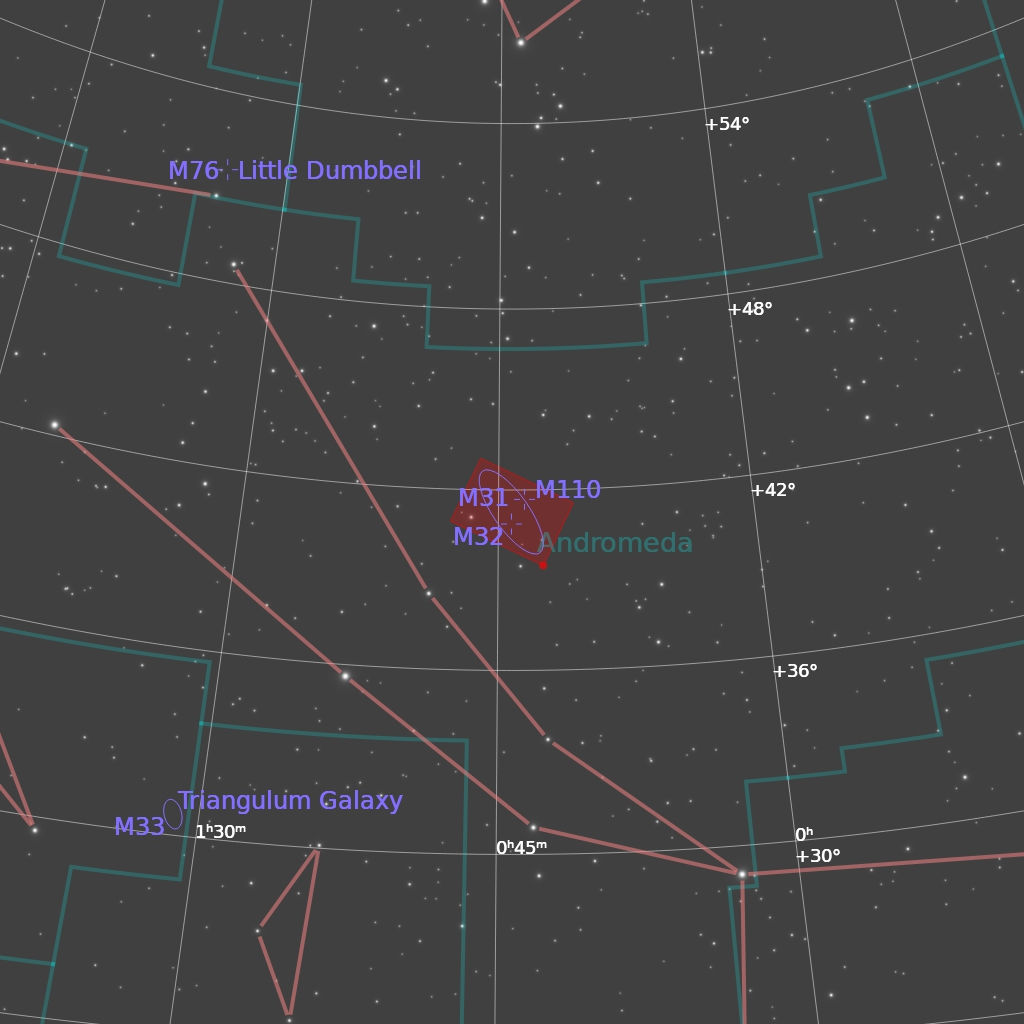
Click to expand
Image Capture
Location:
Big Bend Ranch State Park
Camera:
Total integration: 5h 29m 30s
Integration per filter:
- Baader UV/IR Cut: 54m (18 × 180")
- Baader UV/IR Cut: 1h 20m (40 × 120")
- Baader UV/IR Cut: 1h 17m (77 × 60")
- Baader UV/IR Cut: 58m 30s (117 × 30")
- Hα: 1h (60 × 60")
Coordinates: 0h 42m 36s · +41° 16′ 2″
ZWO ASI294MC-Pro

Awards