Messier 42 (M42) – The Orion Nebula) and Messier 43 (de Mairan's Nebula)
September 8, 2020
Use mouse wheel to zoom, drag to pan, and buttons for other options
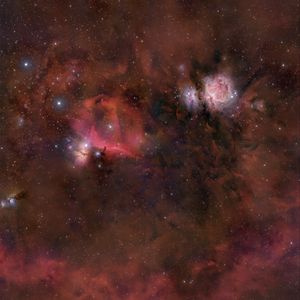
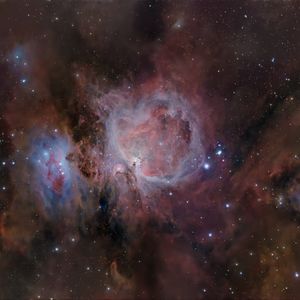
Messier 42 (M42), called the Orion Nebula, is the closest large star-forming region to Earth at a distance of about 1,500 light years. de Mairan's Nebula, Messier 43 (M43) is nestled next to it and is part of the same structure. M42 is one of the only nebulas in the night sky that is visible with the naked eye and forms the brightest part of Orion's sword. Deep inside M42 lies an open star cluster commonly called the Trapezium Cluster. Scientists refer to it as Theta 1 Orionis. The common name comes from the trapezoidal shape the four brightest stars in the cluster form. Galileo discovered the Trapezium in 1617, but only managed to identify three of its stars. Others were discovered later. Here's a close crop showing the Trapezium. You can also zoom into in the picture above.

In 1731 Jean-Jacques d’Ortous de Mairan first identified the eponymous de Mairan's Nebula (M43) as a separate structure. But it's very much part of the Orion Nebula complex, separated only by a dark dust lane. It's illuminated and sculpted by a single massive, hot star, which you can see in the image.


Telescope

Celestron 1100 EdgeHD
Finding Chart

Click to expand
Image Capture
Location:
Back yard in North Dallas
Camera:
Total integration: 1h 19m
Integration per filter:
- Triad Ultra: 1h 19m (237 × 20")
Coordinates: 05h 34m 49.851s · -05° 26′ 8.62″
ZWO ASI2400MC-Pro


Astrobin Top Pick Nomination
Awards