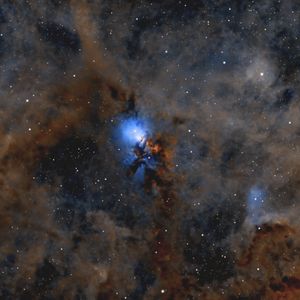
Embryo Nebula (NGC 1333, vdB 17)
October 20, 2022
Use mouse wheel to zoom, drag to pan, and buttons for other options
One of the weirdest-looking things I’ve ever captured, NGC 1333 is a reflection nebula that lies around 960 light years from Earth in the Perseus constellation.
It’s an extremely active star-forming area that is engulfed in a cold, dense molecular cloud—an excellent environment for creating new stars because it’s cold and dense, thus allowing matter to clump together and start attracting more material through gravitational attraction.
The area is packed with Herbig-Haro (HH) objects and young stellar objects (YSOs). There are 138 documented Herbig-Haro objects and 195 documented YSOs in the frame:

Herbig-Haro objects are areas of bright nebulosity created by jets from newly formed stars. A YSO is an object that is producing internal nuclear fusion, but has not quite become a full-fledged star (that is, it has yet to arrive on what scientists call the main sequence).
The dark molecular clouds in the area are excellent locations for star formation because they tend to be colder and denser, thus allowing matter to clump together and start attracting more material through gravitational attraction.
This is an image I was able to capture at the Nightfall star party in Borrego Springs, California in October 2022.


Telescope

Celestron 1100 EdgeHD
Finding Chart

Click to expand
Image Capture
Location:
Borrego Springs, California
Camera:
Total integration: 23h 12m
Integration per filter:
- Lum: 4h 48m (96 × 180")
- R: 4h 51m (97 × 180")
- G: 4h 48m (96 × 180")
- B: 4h 48m (96 × 180")
Coordinates: 3h 29m 4s · +31° 22′ 12″
ZWO ASI6200MM-Pro

Awards