
A Lost Planetary Nebula - PNG 129.5+54
July 31, 2026
Use mouse wheel to zoom, drag to pan, and buttons for other options
Almost due north of the Big Dipper star Megrez (the upper left corner of the bowl), this little planetary nebula catalogued as PNG 129.5+54 is hiding in not-so-plain sight.
A little over a year ago, I embarked on a large mosaic project in and around Ursa Major that looks like it will take three seasons to complete. Also, for a while now, I have been collaborating with Renaud and Olivier Coppe to fish out possible new discoveries in my data. They have an excellent eye for this sort of thing, so my primary duty is capturing and stacking the data while they pore over it for as-yet-unknown objects.
It’s very unlikely that we will find anything new in the field around Ursa Major. It’s been studied since before recorded history began, and it’s high above the galactic plane where there are few planetary nebulas. But at Steve Mandel’s urging, I went ahead and shot a good amount of O3 for each panel just in case.
A couple of weeks ago, we thought we had found an undocumented object that looked very much like a planetary nebula. But upon further review, it turned out to have been catalogued as PNG 129.5+54. Still, I could find no photograph of it anywhere online. It’s an intriguing little planetary nebula that is extremely faint. Only with a significant amount of exposure time did it start to reveal itself.
The name “planetary nebula” is a misnomer. Planetary nebulas have nothing to do with planets. Astronomers in the 18th century thought these objects were planets, but now we know differently. When a star with 80% to 800% of the sun’s mass begins to run out of hydrogen fuel, it starts fusing helium into heavier elements such as carbon and oxygen. As it does this, the additional energy from those stepped-up levels of fusion cause it to expel its outer layers.
Ultimately, the star expels all its outer layers from its core, leaving the core exposed in sort of a cosmic burp. Once all the helium is burned up, fusion ceases in the core and what is left is a giant, dense ball of carbon (about the size of the earth, but with the mass of the sun)—a diamond in the sky called a “white dwarf.” That core no longer produces new energy, but it’s still extremely hot and gives off copious amounts of radiation, ionizing the gas it expelled earlier. That cloud of gas then eventually dissipates. But before it does, the ionized gas gives off light we can record here on earth with our cameras (if the star is close enough to us).
There’s also a significant streak of Ha and O3 below it. I have no idea what that is, but I suspect it could be a remnant from the same supernova that created the Ursa Major Arc, a recently discovered supernova remnant—the leftovers from an exploding star. I’ll leave pinpointing that as an exercise for some future enterprising graduate student.


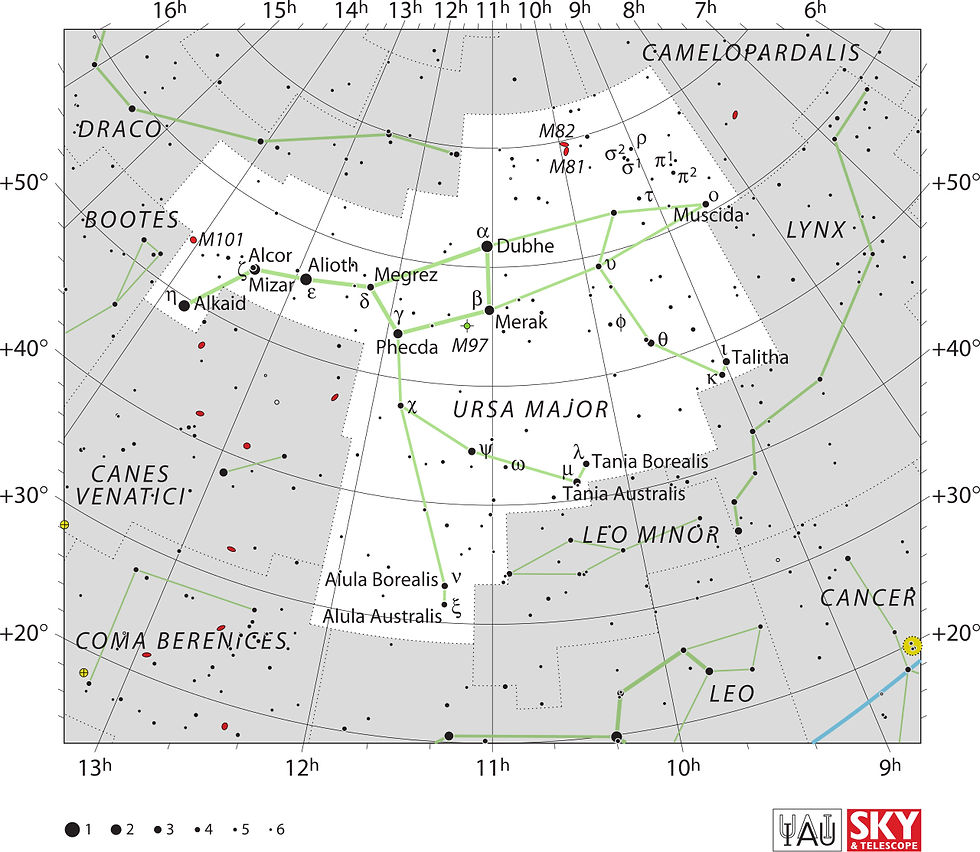


Telescope

Takahashi FSQ106
Finding Chart

Click to expand
Image Capture
Location:
Deep Sky West
Camera:
Total integration: 105h 40m
Integration per filter:
- Lum: 17h 3m (341 × 180")
- R: 12h 27m (249 × 180")
- G: 12h 6m (242 × 180")
- B: 12h 9m (243 × 180")
- Hα: 25h 35m (307 × 300")
- O3: 26h 20m (316 × 300")
Coordinates: 12h 16m 50s · +62° 20′ 12″
Moravian C3-61000


Astrobin Top Pick
Awards
