top of page

Planetary Nebulas

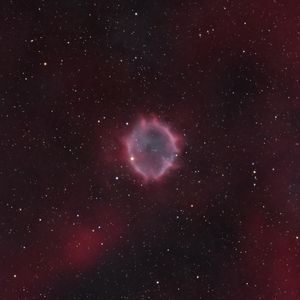
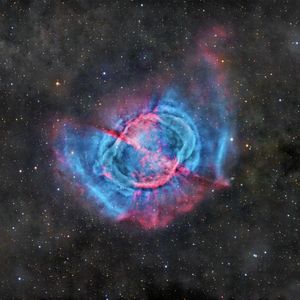
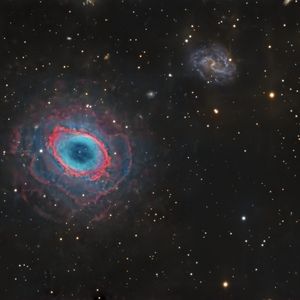
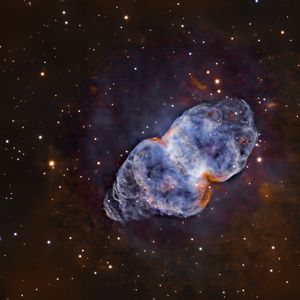
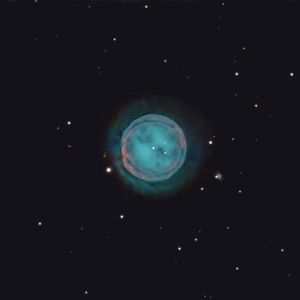
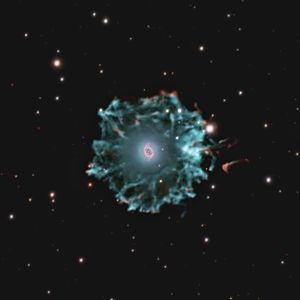
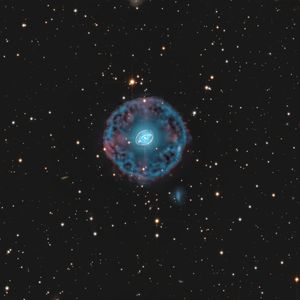
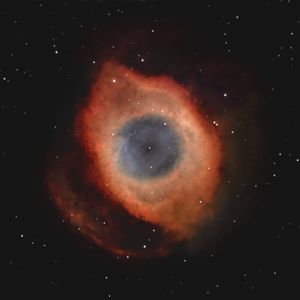
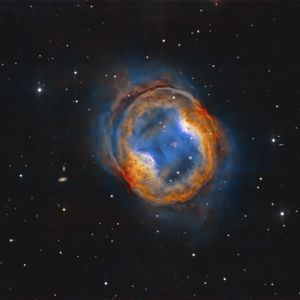
Planetary nebulas exhibit the future of our sun and solar system. But they have little to do with planets and everything to do with stars. This misnomer of a name probably came about when English astronomer William Herschel first observed them in the 1780s and remarked that they looked like planets through his 18th-century optics.


In fact, planetary nebulas herald the death of a star with less than three times the mass of the sun. As such a star burns up all its hydrogen fuel, it starts to burn helium in its core, which produces a much hotter fire in its interior. As a result, it starts to expel its outer layers, which typically includes a great deal of hydrogen and oxygen. Ultimately, the star ejects everything in those outer layers at high velocity—from our vantage, a slow-motion cataclysm that leaves behind only the star's core of mostly carbon. A diamond in the sky called a white dwarf star. 


But the heat from that star also ionizes the gas as it expels it, typically forming ring-like structures that are beautiful to us, but terrible to the planets around the star and any inhabitants those planets may harbor. All that's left of what once may have been a complex solar system is a white dwarf no longer generating new energy, but slowly releasing its stored heat until, in the fullness of time, it becomes a dark, cold cinder aimlessly roaming the galaxy. 
7.jpg
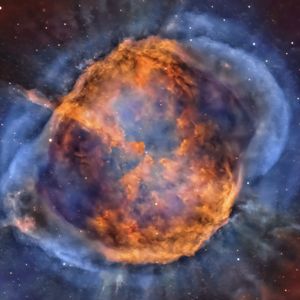
A Look into Our Future – Messier 27 Up Close
7.jpg
A Very Messi Alphabet Soup – Messier 46 (M46) & Messier 47 (M47) Wide Field
7.jpg
Abell 31 (Sh2-290) – A Planetary Nebula in Cancer
7.jpg
Cepheus Four-Panel Narrowband Mosaic 2024
7.jpg
Cepheus Twelve-Panel Narrowband Mosaic 2024-2025
7.jpg
Coppe-Martin 3 (CopMart 3) – The Guardian of Forever
7.jpg
Fraternal Twins – Sh2-216 & 221
7.jpg
Hartl-Dengel-Weinberger 3 (HDW 3)
7.jpg
Hartl-Dengel-Weinberger 3 (HDW3) – Wide Field (Broadband and Narrowband)
7.jpg
Lagoon and Trifid Region Wide Field
7.jpg
Mahna Mahna – Sh2-175, 177, and 179
7.jpg
Messier 25 (M25) and WoMart 1 – Wide Field
7.jpg
Messier 27 (M27) – The Dumbbell Nebula
7.jpg
Messier 46 (M46) and its Planetary Nebulas
7.jpg
Messier 50 (M50) – Wide Field Wonderland
7.jpg
Messier 57 (M57) – The Ring Nebula
7.jpg
Messier 76 (M76) – The Little Dumbbell Nebula
7.jpg
Messier 78 (M78) - Casper the Friendly Ghost Wide Field
7.jpg
Messier 97 (M97) – The Owl Nebula
7.jpg
NGC 6543 (Caldwell 6) - The Cat’s Eye Nebula
7.jpg
NGC 6826 – The Blinking Planetary Nebula
7.jpg
NGC 7293 - The Helix Nebula
7.jpg
Sh2-111 & PNG 081.6-17.5
7.jpg
Sh2-115 & 116 – Wide Field
7.jpg
Sh2-274 (Abell 21) – The Medusa Nebula
7.jpg
Sharpless 2-200—The Bear Claw Nebula
7.jpg
Standoff at the Border – The Boogeyman meets Casper the Friendly Ghost
7.jpg
The Dumbbell Gets the Finger (Messier 27, Sh2-86, and Others)
7.jpg
The Lifecycle of Stars – Star birth, Planetary Nebulas, and Supernovas
7.jpg
Turn It Up to Eleven – The Headphone Nebula – Jones-Emberson 1 (JnEr 1)
7.jpg
Under the Sea – A Cepheus Mosaic
7.jpg
Wocial-Martin 1
7.jpg
vdB 134 & PK086+05.1

Gallery

bottom of page