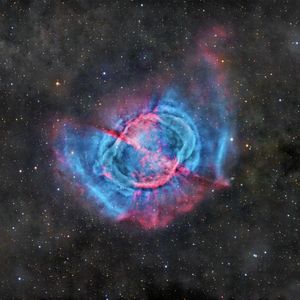
A Look into Our Future – Messier 27 Up Close
August 24, 2024
Use mouse wheel to zoom, drag to pan, and buttons for other options
In about six billion years—just as the Dallas Cowboys are on the cusp of their next Super Bowl appearance—our sun will run out of the hydrogen fuel it has been burning to create helium and other heavier elements. As this happens, its core will collapse to some degree and become more dense. This will increase its temperature and pressure and allow it to start burning heavier elements like helium, which will increase its heat and energy output even further.
This increase in energy will cause the sun’s outer layers to expand over the course of hundreds of millions to billions of years, engulfing Mercury, Venus, and perhaps the Earth or even Mars. That will be its red giant phase.
In its final death throes, it will expel those outer layers and all that will remain will be its core—what is called a white dwarf star—surrounded by a large and growing outflowing of gas called a planetary nebula. The white dwarf will be extremely hot, but it will no longer produce new energy. Over vast amounts of time, perhaps trillions of years, it will cool and become a black dwarf—no longer visible in the night sky from just about any vantage.
Messier 27 (M27), commonly called the Dumbbell Nebula because of its two visible lobes, contains a star going through its planetary nebula phase. The name “planetary nebula” is a misnomer. Planetary nebulas have nothing to do with planets. Astronomers in the 18th century thought these objects were planets, but now we know differently. The gases in planetary nebulas are visible to us primarily because the heat and radiation emanating from the central white dwarf ionizes those gases, causing them to give off their own light much like a neon sign at the local drive-in.
In astronomical terms, planetary nebulas are usually short-lived, remaining visible for only around 25,000 years. M27 finds itself in the middle of that cycle. About 1,200 light years away in the Vulpecula constellation, M27’s central star expelled its gases over a period of thousands of years in fits and starts—a sort of cosmic burping.
While this cosmic burping is nowhere near as energetic as a supernova explosion, make no mistake—this is an extremely violent event. The material near the central star (the gases most recently expelled) are traveling at around 27,000 miles per hour. A little further out, gases originating in an earlier phase of expulsion are traveling at almost 70,000 miles per hour—eight times faster than a rifle bullet!
If M27 were actually our solar system, whatever was left of the Earth, if anything, would be enduring an unsurvivable onslaught from this rage of hot gases pouring over it at incredible speeds for thousands of years. Today, our sun’s surface temperature is around 5,800 degrees Kelvin (9,980 Fahrenheit) and this is the perfect temperature to warm and light the Earth. But if the Earth were in orbit around M27’s central white dwarf, it would be exposed to a star with a surface temperature of 108,600 degrees Kelvin (195,020 degrees Fahrenheit). You’d be able to smoke a 20-pound brisket in about three nanoseconds.
To give you an idea of scale. In the scenario where Earth orbits M27’s central star at a distance of 93 million miles (the Earth’s current distance from the sun), it would be less than a pixel away from the middle of that central star in the image. Each pixel represents approximately 57 times the distance from the Earth to the sun (what astronomers would call 57 astronomical units). So one pixel would stretch from the sun out past the orbit of Pluto and beyond the outer rim of the Kuiper Belt.


Telescope

Planewave CDK12.5
Finding Chart

Click to expand
Image Capture
Location:
Deep Sky West
Camera:
Total integration: 51h 26m
Integration per filter:
- R: 42m (14 × 180")
- G: 42m (14 × 180")
- B: 42m (14 × 180")
- Hα: 20h 40m (248 × 300")
- S2: 17h 30m (210 × 300")
- O3: 11h 10m (134 × 300")
Coordinates: 19h 59m 37s · +22° 43′ 12″
Moravian C5a-100M


Astrobin Top Pick Nomination
Awards