The Dumbbell Gets the Finger (Messier 27, Sh2-86, and Others)
September 6, 2023
Use mouse wheel to zoom, drag to pan, and buttons for other options
Here’s a wide field encompassing some popular astrophotography targets.
Messier 27 (M27)
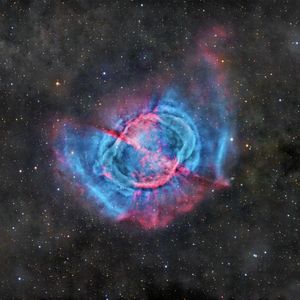
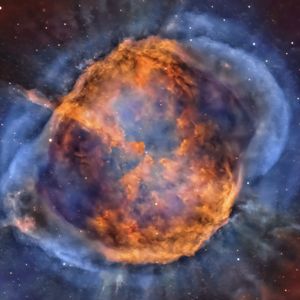
The most well-known and popular one is Messier 27 (M27) in the lower-left corner. I’ve shot this several times with larger, narrower field telescopes. Those other shots include a closer view that combines narrowband (hydrogen and oxygen emissions) and broadband (true-color) imaging techniques as well as an extreme closeup in narrowband that adds sulfur emissions to the mix.
M27 is a planetary nebula approximately 1,200 light years away in the Vulpecula constellation. Age ranges for this object vary dramatically—from 3,000 years to 48,000 years old.
The name “planetary nebula” is a misnomer. Planetary nebulas have nothing to do with planets. Astronomers in the 18th century thought these objects were planets, but now we know differently. When a star with 80% to 800% of the sun’s mass begins to run out of hydrogen fuel, it starts fusing helium into heavier elements such as carbon and oxygen. As it does this, the additional energy from those stepped-up levels of fusion cause it to expel its outer layers.
Ultimately, the star expels all its outer layers from its core, leaving the core exposed in sort of a cosmic burp. Once all the helium is burned up, fusion ceases in the core and what is left is a giant, dense ball of carbon (about the size of the earth, but with the mass of the sun)—a diamond in the sky called a “white dwarf.” That core no longer produces new energy, but it’s still extremely hot and gives off copious amounts of radiation, ionizing the gas it expelled earlier. That cloud of gas then eventually dissipates. But before it does, the ionized gas gives off light we can record here on earth with our cameras (if the star is close enough to us).

Sh2-88
You can find Sh2-88 at the top of the frame to the right of center. Located approximately 7,800 light years away, the larger multicolored region is sub-classified as Sh2-88A, while the two smaller nebulas two the left of the main body are sub-classified as Sh2-88B2 (left) and Sh2-88B1 (right).

Sh2-87
Slightly closer to us at an estimated distance of 7,500 light years, the star-forming complex Sh2-87 lies just below Sh2-88 in the frame. Its filamentary structure indicates that much of the star-forming that is occurring is the result of what scientists call global hierarchical collapse (GHC). GHC occurs when the gases in a nebula start to coalesce because their collective gravitational attractions overcome the countervailing force of thermal pressure that is trying to disperse the gases.

Sh2-86
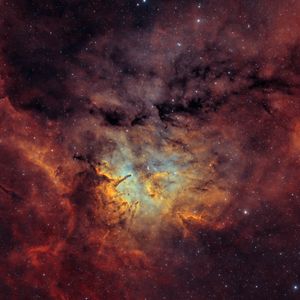
About 6,200 light years away in the Vulpecula (the Little Fox) constellation, Sh2-86 (NGC 6820) is a star-forming region that is home to a couple of Herbig-Haro objects (HH165 & 365). You can find it toward the lower-right of the frame.
The open star cluster NGC 6823 is responsible for ionizing the material in the nebula. A finger-like tower of gas and dust, likely caused by erosion due to the radiation from nearby stars, points toward the heart of the nebula.


Telescope

William Optics ZenithStar 61
Finding Chart

Click to expand
Image Capture
Location:
Back yard in North Dallas
Camera:
Total integration: 36h 4m
Integration per filter:
- R: 46m (46 × 60")
- G: 46m (45 × 60")
- B: 46m (45 × 60")
- Hα: 11h 30m (230 × 180")
- S2: 11h 12m (224 × 180")
- O3: 11h 6m (222 × 180")
Coordinates: 19h 50m 25s · +23° 49′ 3″
ZWO ASI6200MM-Pro

Awards