Cepheus Twelve-Panel Narrowband Mosaic 2024-2025
December 18, 2025
Use mouse wheel to zoom, drag to pan, and buttons for other options
The Cepheus Constellation is a wonderland of many types of objects. In this large mosaic, shot with special narrowband filters, we can easily see the Wizard, Elephant Trunk, Flying Bat, and Lion emission nebulas. There are also a number of dark nebulas including the Seahorse on the far right. The large blue nebula overlaid on the Flying Bat is a recently discovered formation presumed to be a planetary nebula popularly called the Squid. There are at least five very small, but readily visible, planetary nebulas as well as 18 Sharpless emission objects, four van den Bergh reflection nebulas, and one prominent supernova remnant. It took two years to put this shot together, but it was well worth the effort. This is my favorite kind of project to do. And having access to very dark skies, mostly great weather, fabulous optics from Takahashi, and a wonderful camera and filters from Moravian and Chroma makes it possible. I no longer have to be in a hurry dodging clouds and light pollution. Nor do I have to sit outside alternately freezing off my globular clusters in winter or being a pincushion for West Nile carriers in the summer. Please zoom in and have a look around. Note that there's a button on the toolbar that will display labels on the objects to help you sort all this out. And here's some more detail that may also help. When looking at this image, keep in mind that it's a false-color image. That doesn't mean the image is false. It means I have assigned colors to the various ionized gasses represented in the picture to reveal the structure and beauty of the objects it contains. Red is primarily hydrogen. A more orange color indicates the presence of sulfur. And blue represents oxygen gas. In the upper-left corner a supernova remnant (SNR G108.2-0.6)—the remains of an exploded star—shows its blue and red tendrils with the emission nebulas Sh2-147, 148, 149, 152, and 153 peeking in:

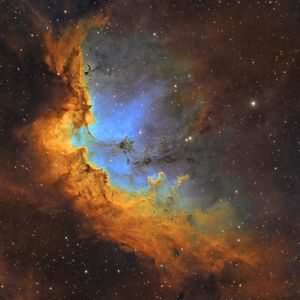
Just to the right (west) is the famous Wizard Nebula (NGC 7380) with its magic hat and outstretched arms casting a spell:

Continuing to move to the west (right), we find Sh2-138 and 139, an underappreciated emission nebula that appears to be the target of the Wizard's incantation:

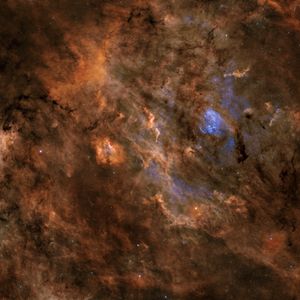
One of the more interesting doodads in the frame is the runaway star Lambda Cephei ( 22 λ Cep)—the blue blob on the right accompanied by Sh2 134 & 135 on the left. On first blush, the blue-tendrilled area around it looks much like a supernova remnant, but it's actually a bow shock created by the massive, hot star as it speeds through the interstellar medium. Runaway stars can be produced through a number of different mechanisms.
One way it occurs when a star is locked in a rapid orbit with a binary companion. The companion explodes in a supernova event, which causes it to lose the majority of its mass. This causes the star to head out into the galaxy (and, ultimately, out of the galaxy) at high velocity. Think of a tether ball spinning on a rope around a pole when the rope suddenly breaks.
Another mechanism is that a massive star passes through a binary star system, disrupting it and accelerating one or both of the binary companions into the void. That, in fact, seems to be what happened to λ Cep:

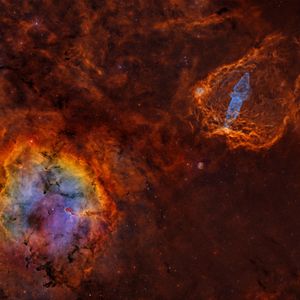
Continuing to move east, we see the red Flying Bat (Sh2-129) and Squid (catalogued as OU4) nebulas, which are very popular, but moderately difficult, targets for amateur astrophotographers. The Flying Bat has been known about for decades. But French amateur astronomer Nicolas Outters discovered the Squid by accident in 2011 when he noticed a distinct structure coming through in frames shot with an oxygen filter. Early consensus was that it is a planetary nebula. But in recent years, further research has been inconclusive:

Just to the west (right) of the Bat and Squid, you can find the Seahorse (Barnard 150). True color imaging actually reveals much more about this dark nebula, but it still shows up nicely in false-color images:

Cycling back toward the southeast (more lower left), you can find the Lion Nebula (Sh2-132), which is primarily the product of energetic outflows from two Wolf-Rayet stars, WR 152 & 153ab:

Traveling west, we come to one of the most popular amateur astrophotography targets in the sky: IC 1396, the Elephant Trunk Nebula. This prolific stellar nursery offers a rich tapestry of color and shape. To provide some perspective, note that the "trunk" moving from the right side toward the center is 20 to 25 light-years long:

Just below-right is Sh2-128, a dainty little HII star-forming region:

The upper lip of the Elephant Trunk Nebula houses the star μ Cep (Mu Cephei), which William Herschel dubbed the Garnet Star because of its deep red color. Above and to its right you can see the planetary nebula PK100+04.1:

Other small, but readily visible, planetary nebulas are sprinkled around the frame. Planetary nebulas form when a star, like our sun, is not massive enough to die in a supernova explosion. It instead burns all its hydrogen fuel and then sheds its outer layers over time, often creating beautiful ring, bipolar, and other intriguing formations. It leaves behind the core of the original star--a hot white dwarf star that no longer produces new energy and will cool slowly over trillions of years. Clockwise from the upper left: NGC 7008 (the Fetus Nebula), PK102-02.1 (Abell 79), PK102-05.1 (Abell 80), PK103+00.2, and PK103+00.1 (Minkowski 2-51):
Finally, I've saved the vdB (van den Bergh) objects for last. The vdB catalogue is filled with some of my personal favorites. vdB objects are typically reflection nebulas, which means they tend not to show up very well when shot with oxygen, sulfur, and hydrogen filters. So I shot some extra true color (RGB) and blended it in to try to give these blue reflection regions more of a presence. Again, clockwise from the upper left, vdB 140 (just below the Flying Bat and Squid), vdB 142 (in the tip of the Elephant's trunk), vdB 148 (between the Lion and the Elephant Trunk), and vdB 144 (below the Elephant Trunk):


Telescope

Takahashi FSQ106
Finding Chart

Click to expand
Image Capture
Location:
Deep Sky West
Camera:
Total integration: 415h 41m
Integration per filter:
- R: 5h 10m (310×60″)
- G: 5h 11' (311×60″)
- B: 5h 10m (310×60″)
- Hα: 109h 25m (1313×300″)
- OIII: 183h 30' (2202×300″)
- SII: 107h 15m (1287×300″)
Coordinates: 21h 52m 26.6s · +57° 36′ 39″
Moravian C3-61000


Astrobin Image of the Day
Awards