
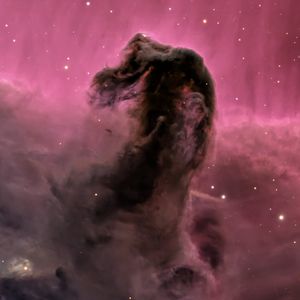
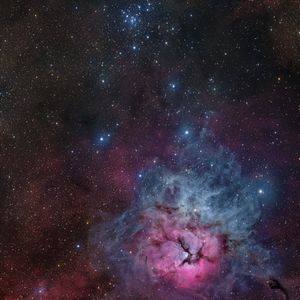
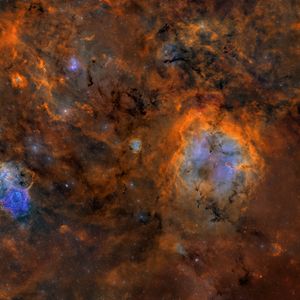
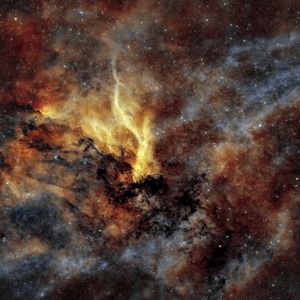
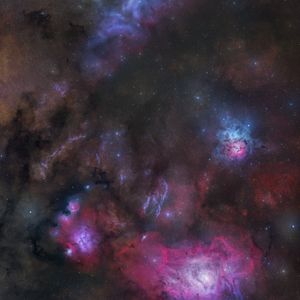
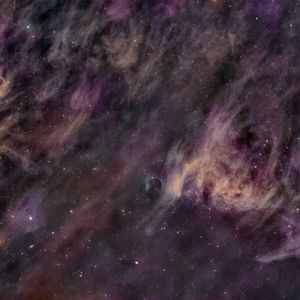
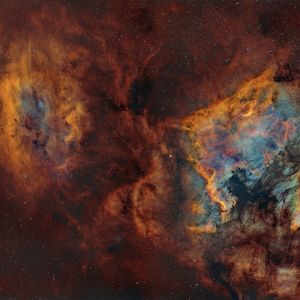
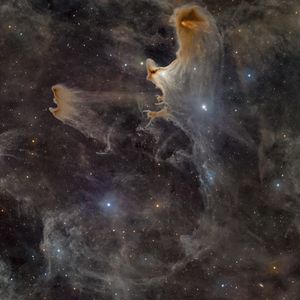
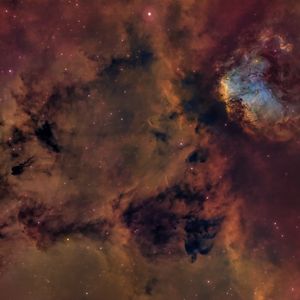
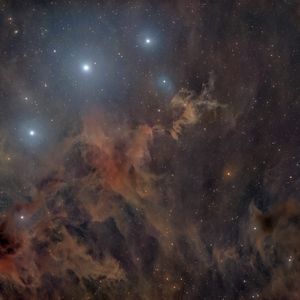
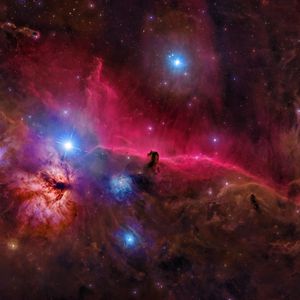
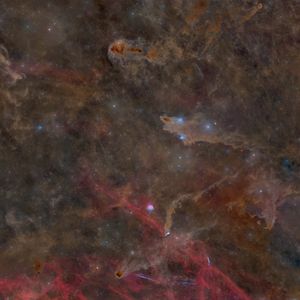
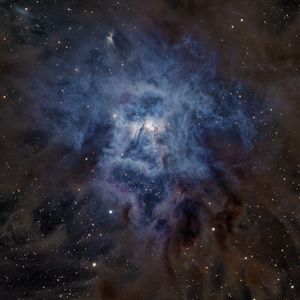
Dark (or absorption) nebulas are dense, cold molecular clouds that block the light from stars in and behind them from our vantage. They typically contain microscopic dust particles coated with water ice, carbon monoxide, carbon dioxide, methane, and ammonia, which block the passage of visible light. They tend to have diffuse, irregular boundaries and are often serpentine in shape.
Because of their cold temperature, dark nebulas can often be the host to prolific new star formation. The colder dust and gas is more likely to condense into a gravitational well that ultimately attracts enough matter to ignite as a star.
Smaller, isolated dark nebulas are sometimes referred to as "Bok Globules"—named after astronomer Bart Bok, who first identified and characterized them in the 1940s.

-Z61-Dillon,%20CO-2022-07-LRGBHa/126_Sh2-126%20and%20the%20Gecko%20(LBN%20437)-Z61-Dillon,%20CO-2022-07-LRGBHa.jpg)
-vdB%2025-FSQ-DSW-LRGB-2025-11/100_Baby%20Eagle%20(LBN%20777)-vdB%2025-FSQ-DSW-LRGB-2025-11.jpg)
