
Fraternal Twins – Sh2-216 & 221
January 25, 2023
Use mouse wheel to zoom, drag to pan, and buttons for other options
The image shows quite an interesting field containing four Sharpless objects and a prominent LBN (Lynds Bright Nebula) object. Stewart Sharpless actually miscategorized Sh2-221 (the large nebula on the left) and Sh2-216 (the large nebula on the right) as HII regions (emission nebulas). While they both contain ionized hydrogen, neither is an emission nebula in the traditional sense. What the image shows is stellar deaths that occurred in two completely different ways.
Sh2-221 – SNR G160.9+2.6 (HB9)
It turns out that Sh2-221 (the large object on the left) is actually a supernova remnant, hence the “SNR” designation—that is, what the supernova explosion left behind. It lies about 2,600 light years away toward the Auriga constellation.
Recently, scientists have questioned whether it is associated with a magnetar (catalogued SGR 0501+4516) or a pulsar (catalogued PSR B0459+46). In either case, this would indicate that the progenitor was a core-collapse, or Type II, supernova. A core-collapse supernova occurs when a massive star runs out of fuel and the material around the core collapses into it at extremely high speed. That material slams into the core and rebounds in a huge explosion.
Core-collapse supernovas typically leave behind one of two types of objects: a neutron star (an extremely dense sphere of exotic matter the size of a city but with the mass of our sun), or a black hole. Neutron stars often spin rapidly producing polar beams of radiation. When those beams sweep by the Earth, we see the pulse from it, hence the name pulsar. A magnetar is a special kind of pulsar that has an insanely strong magnetic field.

Sh2-216 – An Ancient Planetary Nebula
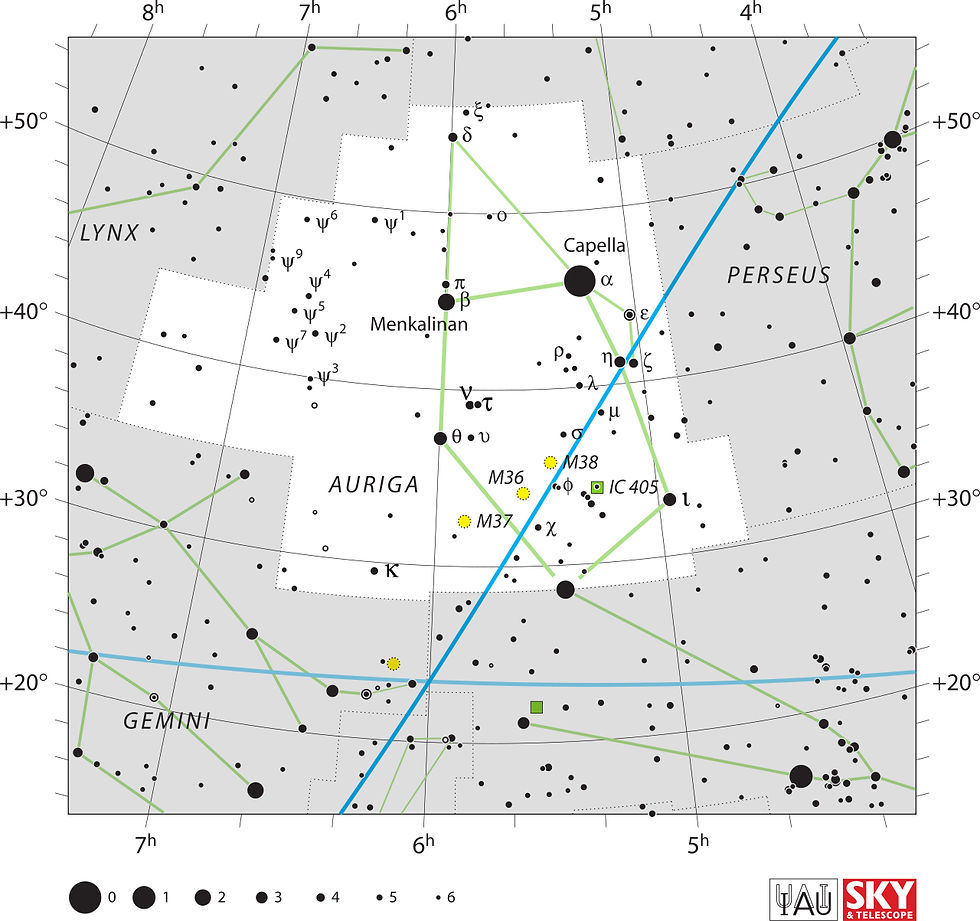
The nebula on the right side of the image is Sh2-216. It turns out that it is not a traditional emission nebula, as Stewart Sharpless thought when he added it to the Sh2 catalogue, but rather, it’s a planetary nebula. In fact, it’s the closest known planetary nebula to Earth at a distance of 416 light years in the Pegasus constellation (the line between Auriga and Pegasus goes right down the middle of the image). And it’s one of the most ancient with an estimated age of around 600,000 years.
A planetary nebula occurs when a star close to the size of our sun runs out of fuel and (relatively) slowly expels its ionized outer layers leaving behind a white dwarf star, which is really just the core of the dead star. They’re not related to planets at all, but astronomers in the 18th century thought they might be planets. They typically only last about 20,000 years before the expelled gas disperses and is too diffuse to detect. That’s why a planetary nebula that is 600,000 years old is so rare.

Sh2-217
Moving back to the left and traveling up above Sh2-221, you can see the true emission nebula Sh2-217. It looks small from our vantage, but looks are deceiving. It’s much farther away than either Sh2-216 or Sh2-221 at a distance of around 14,250 light years.

Sh2-219
Appearing even smaller, Sh2-219 is the orange dot on the upper-right edge of Sh2-221. It’s a very young thing as emission nebulas go with an age of around 100,000 years. It, too, is much farther away than the large objects in the frame with an estimated distance from Earth of 13,000 light years.

LBN 755
LBN 755 is a faint emission nebula catalogued by astronomer Beverly Lynds in her 1965 Catalogue of Bright Nebulae, compiled from photographic plates taken as part of the Palomar Sky Survey. It lies in the constellation Auriga, close to the galactic plane, in a region of sky rich with interstellar gas and dust associated with the Perseus Arm of the Milky Way.
Like many entries in the Lynds catalogue, LBN 755 remains poorly studied in the peer-reviewed literature — a reminder that even in the modern era of astronomy, much of our galaxy's diffuse nebulosity has been catalogued but not yet closely examined.




William Optics ZenithStar 61
Telescope
Finder Chart

Click to expand
Total integration: 30h 39m
Integration per filter:
- R: 20m (40 × 30")
- G: 20m (40 × 30")
- B: 20m (40 × 30")
- Hα: 10h 15m (205 × 180")
- S2: 10h 3m (201 × 180")
- O3: 9h 21m (187 × 180")
Coordinates: 4h 51m 38s · +46° 50′ 4″
Image Capture
Location:
Back yard in North Dallas
Camera:
ZWO ASI6200MM-Pro

Awards
