State of Divergence: California to the Pleiades – A Ten-Panel Mosaic
October 13, 2026
Use mouse wheel to zoom, drag to pan, and buttons for other options
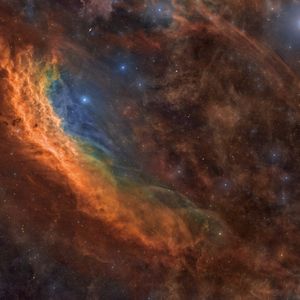
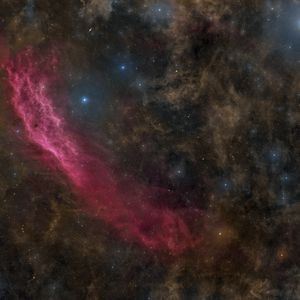
The image depicts a wide field straddling the border that separates the Perseus (left) and Taurus (right) constellations. The headliners of this show are the California Nebula (Sh2-220, NGC 1499, lower left) and the Pleiades (Messier 45, the Seven Sisters, Subaru) along with a small supporting cast. The raison d'être for this picture is to express both the apparent closeness of the two main objects in our sky, and yet also depict the vast physical expanse between them. The image spans an angular area of roughly 15° × 9.5°—enough to fit 570 full moons into the frame!
The Perseus and Taurus Molecular Clouds and the Perseus-Taurus Supershell
The space between California and the Pleiades is filled with red ionized hydrogen streaks as well as a darker material from the Taurus and Perseus molecular clouds. It was once thought that these two molecular clouds were actually touching each other and intermingled, but recent research has shown that not to be the case.
Instead, they are at very different distances from us with the Taurus portion lying about 460 light years away (on average) and the Perseus segment residing approximately 980 light years from Earth (on average). Recent data from the European Space Agency’s Gaia space observatory shows that these two clouds are actually part of a large bubble of gas with a void in the center called the Perseus-Taurus Supershell. The Supershell appears to be the result of a supernova explosion some 10 million years ago. The fact that they appear to be the same object is an optical illusion caused by our viewing angle.
These molecular clouds comprise 99% hydrogen and helium. But they also contain an astonishing array of complex compounds including carbon monoxide, water, hydroxyl, and hydrogen cyanide, among others.
The image below depicts the Supershell with the Perseus cloud in blue and the Taurus cloud in red.

The California Nebula, NGC 1499 & Sh2-220
Probably the most prominent feature in the picture is the California Nebula, catalogued as NGC 1499 and Sh2-220. Glowing brightly with light from hydrogen, sulfur, and oxygen gases, the California Nebula actually sits behind the Perseus molecular cloud at a distance of approximately 1,300 light years. The hot blue supergiant star Menkib (visible above the center of the nebula) is likely responsible for ionizing and illuminating the nebula.

vdB 19 and IC 348
Moving up and to the right from California, you can find IC 348 and vdB 19 (the bluish area inside the large red blob). IC 348 is a large, young star-forming region and star cluster in Perseus about 1,000 light years away. The Spitzer Space Telescope has found many young stars with circumstellar disks—evidence that planets may be forming along with the new stars. The reflection region vdB 19 is associated with IC 348. The general area also contains lanes of dark, cold dust (catalogued as Barnard 3 and Barnard 4), which are ideal sources of material for forming new stars.

NGC 1514 – The Crystal Ball Nebula
Directly to the right of the southern part of the California Nebula, you can find the tiny (in this picture) Crystal Ball Nebula, NGC 1514. The Crystal Ball is a planetary nebula that resides approximately 2,300 light years from us on the Taurus side of the constellation boundary. The material you see is primarily ionized hydrogen (red or pink) and oxygen (blue) gas that a dying star ejected around 3,800 years ago.
The name “planetary nebula” is a misnomer. Planetary nebulas have nothing to do with planets. Astronomers in the 18th century thought these objects were planets, but now we know differently. When a star with 80% to eight times the sun’s mass begins to run out of hydrogen fuel, it starts fusing helium into heavier elements such as carbon and oxygen. As it does this, the additional energy from those stepped-up levels of fusion cause it to expel its outer layers.
Ultimately, the star expels all its outer layers from its core, leaving the core exposed in sort of a cosmic burp. Once all the helium is burned up, fusion ceases in the core and what is left is a giant, dense ball of carbon (about the size of the earth, but with the mass of the sun)—a diamond in the sky called a “white dwarf.” That core no longer produces new energy, but it’s still extremely hot and gives off copious amounts of radiation, ionizing the gas it expelled earlier. That cloud of gas then eventually dissipates. But before it does, the ionized gas gives off light we can record here on earth with our cameras (if the star is close enough to us).

LBN 777 – The Baby Eagle Nebula
Continuing to the right and moving up a bit, the Baby Eagle Nebula (LBN 777) sits in its nest. The incomparable Beverly Lynds documented this object in her Catalogue of Bright Nebulas in 1965. It’s actually part reflection nebula and part dark molecular cloud.

vdB 25
Near the lower-right corner of the frame, you can find vdB 25, a small reflection nebula. It’s distance estimate of 460 light years puts it squarely in the midst of the Taurus Molecular Cloud.

Messier 45 (M45) – The Pleiades
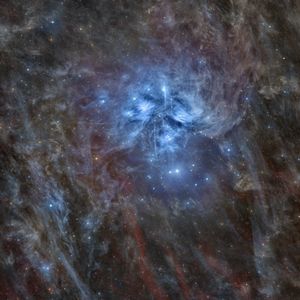
To me, the real star of this show is Messier 45, the Pleiades (also called the Seven Sisters and Subaru). Seen in the upper-right corner of the image, it’s an open star cluster containing around 1,000 stars lying about 445 light years away.
People have watched the Pleiades and wondered about it since before recorded history began. In Greek Mythology, the Seven Sisters (Maia, Alcyone, Asterope, Celaeno, Taygete, Electra, and Merope) were the daughters of the Titan Atlas and the sea nymph Pleione.

The hunter Orion pursued the Seven Sisters for seven years. Zeus (after fathering children with three of them) changed them into doves and placed them in the heavens to protect them from Orion.
The astronomical object is easily visible with the naked eye in the northern-hemisphere winter sky. But the surrounding faint blue nebulosity and red ionized hydrogen gas so readily apparent in long-exposure photography is much more elusive to the unaided eye.

Several of the brightest stars in the Pleiades are named after the sisters and also catalogued as vdB objects.
Clockwise from left: vdB 21 – Maia and the Maia Nebula; vdB 20 – Electra and the Electra Nebula; vdB 22 – Merope and the Merope Nebula; and vdB 23 – Alcyone and the Alcyone Nebula
Completing an image of this nature is a great deal of work—one-hundred-ten nights over the course of three years. But seeing it come together is also very gratifying. It wouldn’t be possible without the forbearance of my family and the work of others in pointing the way and providing solid technical and infrastructure foundations.


Telescope

Takahashi FSQ106
Finding Chart

Click to expand
Image Capture
Location:
Deep Sky West
Camera:
Total integration: 363h 48m
Integration per filter:
- Lum: 76h 39m (1538 × 180")
- R: 54h 15m (1085 × 180")
- G: 53h 18m (1066 × 180")
- B: 53h 6m (1062 × 180")
- Hα: 90h 10m (1082 × 300")
- S2: 18h 10m (218 × 300")
- O3: 18h 10m (218 × 300")
Coordinates: 3h 55m 15s · +30° 14′ 29″
Moravian C3-61000

Awards