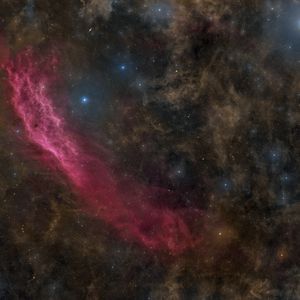
The California Nebula – NGC 1499 (Sh2-220) in Narrowband and True Color
April 6, 2026
Use mouse wheel to zoom, drag to pan, and buttons for other options
Five times longer than the moon is wide from our point of view, the California Nebula is a giant emission nebula in the Perseus constellation. According to the Gaia survey, it’s about 1,300 light years away, give or take 200 light years.
The main body of the nebula is about 100 light years in length. The main ionizing force seems to be the star Zeta Persei, which is the bright blue star just to the right of the upper part of the nebula.
A favorite of astrophotographers, it can be captured with both broadband (true color) and narrowband (false color) techniques. In true color, it presents a striking pink appearance from the light emissions of ionized hydrogen that dominates its composition. In narrowband, astrophotographers can isolate the light coming from ionized hydrogen, sulfur, and oxygen to compose a false-color image that reveals much more about its extent, structure, and chemistry.
Note that the area it lives in also contains giant molecular clouds that stretch from the California Nebula in Perseus to the Pleiades star cluster in Taurus and beyond. You can see these as the chocolate-colored formations in the true-color image and as more orange-red in the image that combines true color with false color. These clouds contain many different complex molecules, some of them organic.
This image is a two-panel mosaic that will ultimately be part of a much larger multi-year composition.


Telescope

Takahashi FSQ106
Finding Chart

Click to expand
Image Capture
Location:
Deep Sky West
Camera:
Total integration: 102h 3m
Integration per filter:
- Lum/Clear: 15h 6m (302 × 180")
- R: 11h 6m (222 × 180")
- G: 10h 36m (212 × 180")
- B: 10h 45m (215 × 180")
- Hα: 18h 10m (218 × 300")
- S2: 18h 10m (218 × 300")
- O3: 18h 10m (218 × 300")
Coordinates: 4h 3m 37s · +34° 43′ 40″
Moravian C5a-100M


Astrobin Top Pick
Awards