Hartl-Dengel-Weinberger 3 (HDW 3)
March 29, 2026
Use mouse wheel to zoom, drag to pan, and buttons for other options
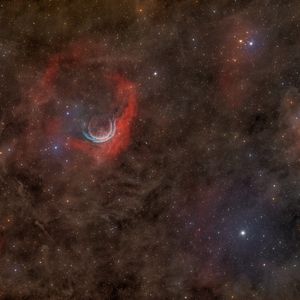
HDW3 is an ancient planetary nebula in Perseus. The strange braided borders are the result of the gas from the planetary nebula colliding with the gases that were already around it.
This is another one of those objects that represents the future of our sun. The central star has burned all its hydrogen and expelled its external layers. The resulting white dwarf at the center is now ionizing the expelled gas making it visible from Earth. The progenitor star is the tiny blue star pointed to in this crop:

Discovered in 1982 by Ronald Weinberger, Johann Dengel, and Herbert Hartl, they estimated its distance at about 1,043 light years. Although they did not estimate an age, they do say this is a highly developed planetary nebula indicating ancient origins.
This particular image isolates (except for the stars, which were shot in broadband) the light emissions coming from hydrogen gas (red) and oxygen gas (blue)—two common gasses expelled by dying stars. There's an alternate version accessible with the slideshow controls above that employs a dynamic color combination called the Foraxx Palette (a color mapping technique that blends hydrogen and oxygen emissions in a way that produces more dynamic color gradients than traditional narrowband palettes).


Telescope

Takahashi TOA130
Finding Chart

Click to expand
Image Capture
Location:
Deep Sky West
Camera:
Total integration: 75h 28m
Integration per filter:
- R: 1h 6m (22 × 180")
- G: 1h 6m (22 × 180")
- B: 1h 6m (22 × 180")
- Hα: 32h 10m (193 × 600")
- OIII: 40h (240 × 600")
Coordinates: 3h 26m 50s · +45° 16′ 32″
Moravian C5a-100M


Astrobin Top Pick Nomination
Awards