Messier 25 (M25) and WoMart 1 – Wide Field
June 20, 2025
Use mouse wheel to zoom, drag to pan, and buttons for other options
Messier 25 (M25) is an open star cluster roughly 2,000 light years from Earth and 67 million years old. It’s about 19 light years across and contains around 600 stars.
Open star clusters (or “open clusters”) are collections of stars—perhaps a few dozen to a few thousand—that likely formed in the same molecular cloud, but are not gravitationally bound to each other. They eventually wander away from each other and find their own paths through the galaxy. Our own sun was probably once part of an open cluster at one time but has since moved out on its own.
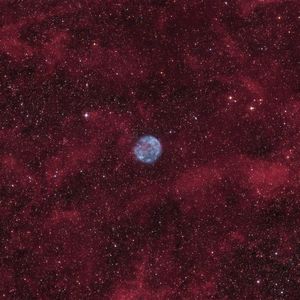
Sometimes an image presents things you don’t expect. This image is very special to me because it spurred the confirmation of my first new discovery, WoMart 1. After I published this image on Astrobin, Thomas Wocial with the University of Herfordshire, contacted me to point out that it contained what looked to be an undocumented planetary nebula.
Over the course of the next few weeks, with the help of Dana Patchick, Thomas and I prepared a submission to the authorities. Several months later, it was approved and is now listed in the Hong Kong/AAO/Strasbourg planetary nebula database as PNG 016.8-04.5 and WoMart 1. It still needs to be confirmed as a planetary nebula through spectral analysis.
Here’s a crop from this image, but there’s a link to a much better image of it taken with a much larger telescope below in the Related Images section.

The name “planetary nebula” is a misnomer. Planetary nebulas have nothing to do with planets. Astronomers in the 18th century thought these objects were planets, but now we know differently. When a star with 80% to 800% of the sun’s mass begins to run out of hydrogen fuel, it starts fusing helium into heavier elements such as carbon and oxygen. As it does this, the additional energy from those stepped-up levels of fusion cause it to expel its outer layers.
Ultimately, the star expels all its outer layers from its core, leaving the core exposed in sort of a cosmic burp. Once all the helium is burned up, fusion ceases in the core and what is left is a giant, dense ball of carbon (about the size of the earth, but with the mass of the sun)—a diamond in the sky called a “white dwarf.” That core no longer produces new energy, but it’s still extremely hot and gives off copious amounts of radiation, ionizing the gas it expelled earlier. That cloud of gas then eventually dissipates. But before it does, the ionized gas gives off light we can record here on earth with our cameras (if the star is close enough to us).


Telescope

Takahashi FSQ106
Finding Chart

Click to expand
Image Capture
Location:
Deep Sky West
Camera:
Total integration: 32h 41m
Integration per filter:
- R: 42m (42 × 60")
- G: 42m (42 × 60")
- B: 42m (42 × 60")
- Hα: 7h (84 × 300")
- S2: 7h (84 × 300")
- O3: 7h 15m (87 × 300")
Coordinates: 18h 33m 10s · -18° 26′ 24″
Moravian C3-61000

Awards