
NGC 6543 (Caldwell 6) - The Cat’s Eye Nebula
June 18, 2022
Use mouse wheel to zoom, drag to pan, and buttons for other options
The Cat’s Eye was one of the first planetary nebulas ever discovered—and it was the very first where the progenitor star was identified. Sir William Herschel discovered it in 1786 and classified it as a planetary nebula because through his 18th-century optics, it had a round shape and looked like a planet. But in 1864, English amateur astronomer William Huggins examined its spectrum and determined that it was largely gaseous in nature rather than stellar or planetary.
Most planetary nebulas have a central white dwarf star that is responsible for expelling the gasses that form them. When a star of intermediate size runs out of hydrogen to burn, it starts burning helium, which heats it up and causes it to propel its outer layers into space. Ultimately, the star runs out of fuel and leaves behind the core of the star—still hot, but no longer producing new energy. This star is typically the size of the Earth but has the mass of the sun. This dense object is now called a white dwarf star and will remain very hot for billions, and perhaps trillions of years.
The Cat’s Eye, however, is unusual in that its central progenitor is a massive, hot Wolf-Rayet star, rather than a white dwarf. It’s also one of the most complex planetary nebulas ever observed, containing myriad bubbles, filaments, and concentric rings. The reasons for this are not yet known, but the cause could be a number of things including interaction with a hidden binary companion.
Although the progenitor star likely began shedding its outer layers tens of thousands of years ago, scientists believe that the main portion of the planetary nebula formed around 1,000 years ago.
About a year after taking the picture above, I turned my planetary rig toward the core of NGC 6543 to try to get a detailed closeup. I think it was a decent effort, and you can see some of the major features of the core:

But my image of the core in no way compares to the image the Hubble Space Telescope took in early 2025:

I was fortunate enough to have this image selected as Amateur Astronomy Picture of the Day for July 2, 2022 and Picture of the Month for July of that year.


Telescope

Celestron 1100 EdgeHD
Finding Chart
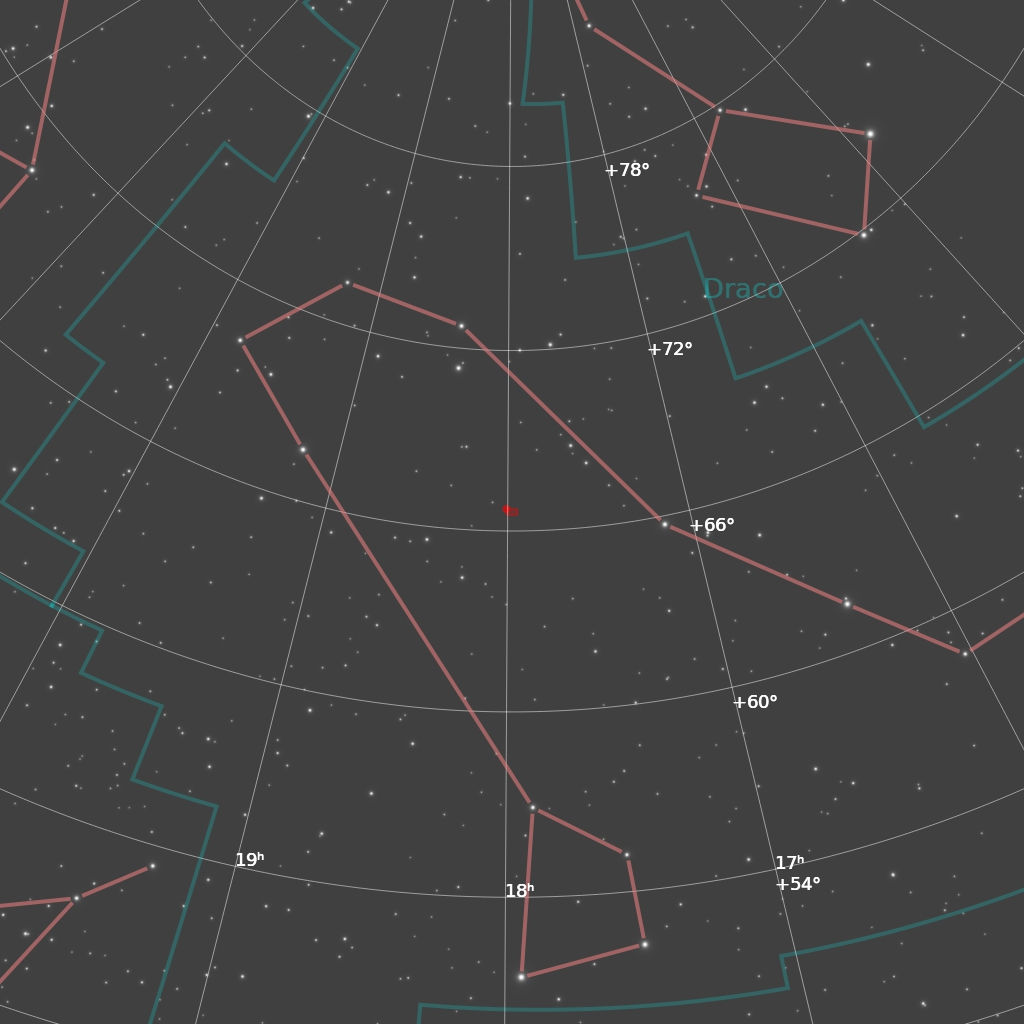
Click to expand
Image Capture
Location:
Back yard in North Dallas
Camera:
Total integration: 25h 56m 51s
Integration per filter:
- Lum: 106×1″(1′ 46″)
- Lum: 60×10″(10′)
- Lum: 92×60″(1h 32′)
- Lum: 60×30″(30′)
- Red: 70×30″(35′)
- Red: 113×1″(1′ 53″)
- Red: 39×10″(6′ 30″)
- Red: 71×60″(1h 11′)
- Green: 55×10″(9′ 10″)
- Green: 75×30″(37′ 30″)
- Green: 74×60″(1h 14′)
- Green: 59×1″(59″)
- Blue: 63×1″(1′ 3″)
- Blue: 30×10″(5′)
- Blue: 68×30″(34′)
- Blue: 74×60″(1h 14′)
- Hα: 139×180″(6h 57′)
- Hα: 82×30″(41′)
- Hα: 80×60″(1h 20′)
- O3: 136×180″(6h 48′)
- O3: 90×30″(45′)
- O3: 82×60″(1h 22′)
Coordinates: 17h 58m 33s · +66° 38′ 3″
ZWO ASI6200MM-Pro


Amateur Astronomy Picture of the Day Monthly Winner

Amateur Astronomy Picture of the Day
Awards
