Lagoon and Trifid Region Wide Field
August 7, 2024
Use mouse wheel to zoom, drag to pan, and buttons for other options
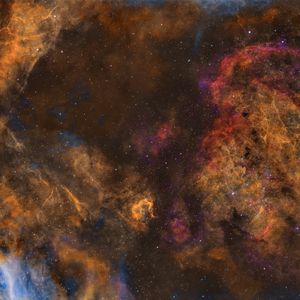
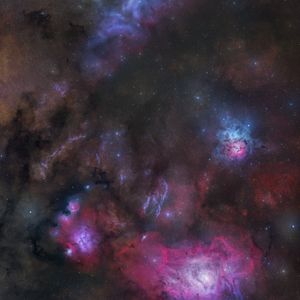
This image expresses a large area in the Sagittarius constellation and contains many notable objects. There are links of more isolated, higher-resolution images of most all of these objects, but here I wanted to create an image that placed them in context. Note this this image is a true-color image, where some of the aforementioned linked images have both true-color and false-color narrowband versions.
vdB 115 (IC 4684)
vdB 115 is a reflection nebula roughly 5,400 light years away. It’s illuminated by the star noted in the Henry Draper Catalogue (HD), HD 165872. vdB 115 is visible toward the upper-left corner of the image.

Draper’s catalogue relied to a great degree on the work of the Harvard Computers, a group of women at the Harvard College Observatory, led by Williamena Fleming and Annie Jump Cannon, who compiled data and classified thousands of stars in the late 19th and early 20th centuries. The enduring value of their work to the science of astronomy cannot be overestimated.

NGC 6559 – The Cosmic Baseball Glove
Just below vdB 115, you can find the much larger NGC 6559—what I call the Cosmic Baseball Glove. Lying approximately 5,000 light years from Earth, the region around NGC 6559 is diverse and intricate. A star-forming region primarily comprising red ionized hydrogen gas, the area also contains lanes of cold, black molecular dust. The most prominent of these (seen in the “palm” of the glove) is often referred to as the Chinese Dragon Nebula. The Glove is further divided into three Sharpless objects.

Sh2-29
Sh2-29 comprises the area I would refer to as the palm of the Glove. This is a prolific star-forming region tortured by radiation from young stars as well as their magnetic fields.

Sh2-31
Sh3-31 is what I would call the middle finger of the glove. The two large multiple star systems HD 165921 and HD 166107 ionize the region (two more examples of stars catalogued by the Harvard Computers).

Sh2-32
The forefinger of the glove, Sh2-32, not only displays qualities of a red emission region, but is also circumnavigated by blue reflection material. Scientists have observed both gamma rays and X-rays emanating from within Sh2-32.

Perek-Kohoutek (PK) 006-02.1
Perek-Kohoutek (PK) 006-02.1 is a tiny (from our point of view) planetary nebula just below NGC 6559. The Perek-Kohoutek Catalogue of Galactic Planetary Nebulae, published in 1967 contains 1,510 entries for planetary nebulas in our galaxy. It’s distance from us, estimated at about 2,700 light years, is considerably closer than most of the other objects in the image. In 1946, German-American astronomer Rudolph Minkowski discovered this planetary nebula and gave it his own catalogue designation, M 1-41. It’s central star is spectacularly hot at 142,400 degrees Kelvin (255,860 degrees Fajrenheit).
The name “planetary nebula” is a misnomer. Planetary nebulas have nothing to do with planets. Astronomers in the 18th century thought these objects were planets, but now we know differently. When a star with 80% to eight times the sun’s mass begins to run out of hydrogen fuel, it starts fusing helium into heavier elements such as carbon and oxygen. As it does this, the additional energy from those stepped-up levels of fusion cause it to expel its outer layers.
Ultimately, the star expels all its outer layers from its core, leaving the core exposed in sort of a cosmic burp. Once all the helium is burned up, fusion ceases in the core and what is left is a giant, dense ball of carbon (about the size of the earth, but with the mass of the sun)—a diamond in the sky called a “white dwarf.” That core no longer produces new energy, but it’s still extremely hot and gives off copious amounts of radiation, ionizing the gas it expelled earlier. That cloud of gas then eventually dissipates. But before it does, the ionized gas gives off light we can record here on earth with our cameras (if the star is close enough to us).

Supernova Remnant G007.5-01.7
To the right (west) of NGC 6559 lies the very faint supernova remnant (SNR) G007.5-01.7. I haven’t found a ton of information about this SNR, but Chandra did gather some data. Based on this data, it appears to be about 6,523 light years away. It also appears that the shell is about 50,000 years old, while the pulsar is approximately 23,000 years old. Using Gary Imm’s formula for calculating object size [4.85e-6 X width(px) X “/px X distance(ly)], I get a size of about 191 light years for the elements visible in this image.

Messier 8 (M8, NGC 6523, Sh2-25) – The Lagoon Nebula
Messier 8 (M8), the Lagoon Nebula (the large object bottom center), is one of the brightest, and most beautiful, emission nebulas in the sky above us. It’s also one of the most popular amateur astrophotography targets. It’s so bright, that true-color imaging produces almost as much structural information as narrowband imaging with specialized filters does. And it’s even visible to the naked eye under the right conditions.
Located about 5,200 light years away in the Sagittarius constellation, the Lagoon is home to a number of bright, massive stars that ionize its gases and cause them to emit their own light. With a span of 140 x 60 light years, the Lagoon is more than three times the size of the full moon from our vantage. It’s one of the larger star factories in the galaxy. It contains a number of cold, dark globules and Herbig-Haro objects generally associated with the creation of new stars.
John Herschel named the Lagoon’s bright central region the “Hourglass Nebula” because of its swirling, double-triangle shape.

Messier 20 (M20, NGC 6514, Sh2-30) – The Trifid Nebula
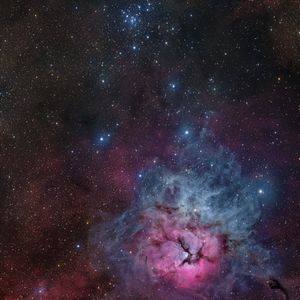
If Messier 31, the Andromeda Galaxy, is the Stairway to Heaven and Messier 42, the Great Orion Nebula, is the Don’t Stop Believin’, then Messier 20 (M20), the Trifid Nebula (at the bottom of the frame), is the Afternoon Delight of amateur astrophotographers. A prolific star-forming region roughly 5,000 light years from Earth, the Trifid gets its name from its three prominent blue lobes.
The Trifid is both a reflection nebula illuminated by nearby stars as well as an emission nebula that generates its own light from ionized gasses. It also contains dark absorption nebula lanes that contribute to its name because they divide the main body into three parts. This rendering shows it in true color. It’s what you might see if your eyeball were 20 stories tall and you could stare at it for 20 hours without blinking.
On the upper-left corner of the Trifid, the red hydrogen emission material is catalogued as Sh2-30, although Sh2-30 is often used to characterize the entire Trifid Nebula.

Sh2-28
Like the guitar tech for Jimmy Page and John Paul Jones, Sh2-28 lives out its inconspicuous life in obscurity between the superstar Lagoon Nebula and the pop-legend Trifid Nebula. This image comes from data that I’ve had for a couple of years. But I didn’t realize it contained this entry in the Sharpless catalogue. So I had to dig it out to add to my collection.
D. Russell approximates the distance to Sh2-28 at around 8,150 light years. I can’t find a lot written about Sh2-28 in the literature other than the fact that its original coordinates are incorrect—part of a series of coordinates that Stewart Sharpless recorded incorrectly. So it appears that despite what the overlay shows, Sh2-28 is actually the larger blob on the right rather than the sparsely populated space on the left.


Telescope

Takahashi TOA130
Finding Chart

Click to expand
Image Capture
Location:
Deep Sky West
Camera:
Total integration: 29h 32m
Integration per filter:
- Lum: 7h 3m (141 × 180")
- R: 4h 57m (99 × 180")
- G: 4h 42m (94 × 180")
- B: 4h 45m (95 × 180")
- O3: 8h 5m (97 × 300")
Coordinates: 18h 5m 8s · -23° 52′ 40″
Moravian C5a-100M


Amateur Astronomy Picture of the Day

Astrophotography Prize Highly Commended

Astrobin Top Pick Nomination
Awards