Messier 8 (M8) – The Lagoon Nebula
August 7, 2024
Use mouse wheel to zoom, drag to pan, and buttons for other options
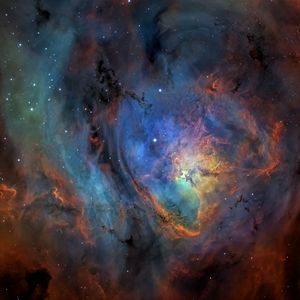
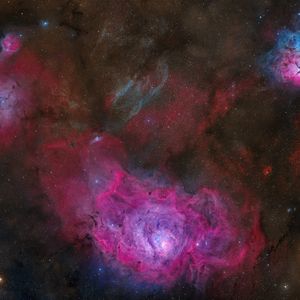
Messier 8 (M8), the Lagoon Nebula, is one of the brightest, and most beautiful, emission nebulas in the sky above us. It’s also one of the most popular amateur astrophotography targets. It’s so bright, that true-color imaging produces almost as much structural information as narrowband imaging with specialized filters does. And it’s even visible to the naked eye under the right conditions.
Located about 5,200 light years away in the Sagittarius constellation, the Lagoon is home to a number of bright, massive stars that ionize its gases and cause them to emit their own light. With a span of 140 x 60 light years, the Lagoon is more than three times the size of the full moon from our vantage. It’s one of the larger star factories in the galaxy. It contains a number of cold, dark globules and Herbig-Haro objects generally associated with the creation of new stars.
John Herschel named the Lagoon’s bright central region the “Hourglass Nebula” because of its swirling, double-triangle shape.
For this website entry, I’ve created a slideshow using two images: the first is a narrowband image taken with specialized filters to isolate the structures of ionized hydrogen, oxygen, and sulfur gases. The second is a true-color image, which is what you might see if your eyeball were as tall as the Empire-State Building and you could stare at the Lagoon for 32 hours without blinking.


Telescope

Takahashi TOA130
Finding Chart

Click to expand
Image Capture
Location:
Deep Sky West
Camera:
Total integration: 39h 17m
Integration per filter:
- Lum: 7h 3m (141 × 180")
- R: 4h 47m (99 × 180")
- G: 4h 42m (94 × 180")
- B: 4h 45m (95 × 180")
- Hα: 5h 20m (64 × 300")
- S2: 5h 15m (63 × 300")
- O3: 7h 15m (87 × 300")
Coordinates: 18h 2m 11s · -23° 32′ 44″
Moravian C5a-100M


Astrobin Top Pick Nomination
Awards