Messiers 8 (The Lagoon Nebula), 20 (The Trifid Nebula), and 21 (Webb’s Cross) with Other Notable Figures
August 21, 2025
Use mouse wheel to zoom, drag to pan, and buttons for other options
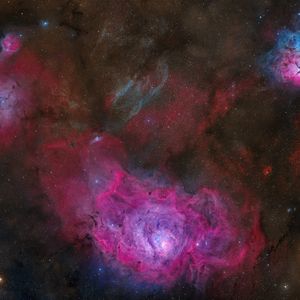
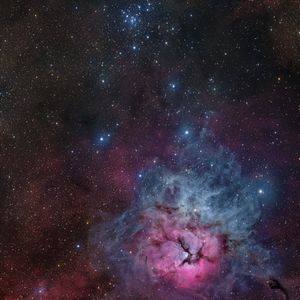
The area around Messier 8 (M8), the Lagoon Nebula) contains a large number of significant astronomical phenomena. Other than the Lagoon, the most famous are Messier 20 (M20), the Trifid Nebula, and Messier 21 (Webb’s Cross).
We’ll start at the top of the frame and work our way down.
vdB 113
Fron Sidney van den Bergh’s catalogue of reflection nebulas, vdB 113 is about 3,020 light years away in the Sagittarius constellation. It is illuminated by a white supergiant star catalogued as HD 165784.

Sharpless 2-34 (Sh2-34)
Sh2-34 is a large emission nebula nearby that comprises primarily hydrogen (red), although the ionized oxygen (blue) in it is very strong. Distance estimates for Sh2-34 place it at almost 4,600 light years from Earth.

Messier 21 (M21), Webb’s Cross
M21, also called Webb’s Cross, is an open star cluster (a group of stars that were likely born together at around the same time but are not gravitationally bound) that is about eight million years old. The cluster resides in the Sagittarius constellation approximately 4,250 light years away.
The name Webb’s Cross comes from the 1859 book Celestial Objects for Common Telescopes written by influential English amateur astronomer Rev. Thomas William Webb.

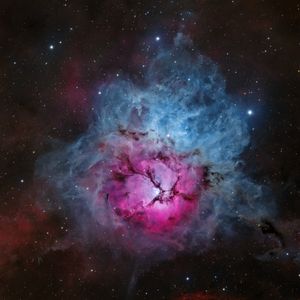
Messier 20 (M20), the Trifid Nebula
If Messier 31, the Andromeda Galaxy, is the Stairway to Heaven and Messier 42, the Great Orion Nebula, is the Don’t Stop Believin’, then Messier 20 (M20), the Trifid Nebula is the Afternoon Delight of amateur astrophotographers. A prolific star-forming region roughly 5,000 light years from Earth, the Trifid gets its name from its three prominent blue lobes.
The Trifid is both a reflection nebula illuminated by nearby stars as well as an emission nebula that generates its own light from ionized gasses. It also contains dark absorption nebula lanes that contribute to its name because they divide the main body into three parts. This rendering shows it in true color. It’s what you might see if your eyeball were 20 stories tall and you could stare at it for 20 hours without blinking.
On the upper-left corner of the Trifid, the red hydrogen emission material is catalogued as Sh2-30, although Sh2-30 is often used to characterize the entire Trifid Nebula.

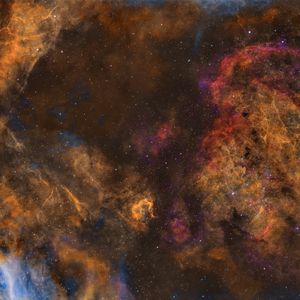
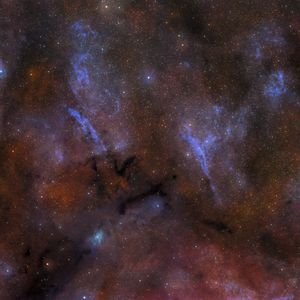
Supernova Remnant (SNR) G007.5-1.7
I haven’t found a ton of information about this SNR, but Chandra did gather some data. Based on this data, it appears to be about 6,523 light years away. It also appears that the shell is about 50,000 years old, while the pulsar is approximately 23,000 years old. Using Gary Imm’s formula for calculating object size [4.85e-6 X width(px) X “/px X distance(ly)], I get a size of about 191 light years for the elements visible in this image. A supernova remnant is what is left behind when a star explodes.
Consider that it would take two to four times that 23,000 years for Voyager to reach the nearest star, Proxima Centauri. The remains of SNR G007.5-1.7 have traveled 90 light years in 23,000 years. This means that material has sped away from its point of origin (by my possibly faulty math) at an average speed of around 2.7 million miles per hour!

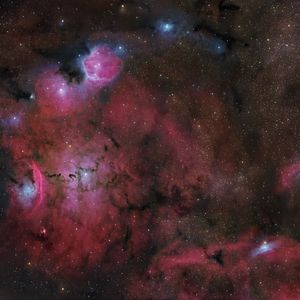
NGC 6559 – The Cosmic Baseball Glove
The baseball glove moniker is my own lame invention, but I think it’s apt. Lying approximately 5,000 light years from Earth and, visually, is a neighbor of the much larger Messier 8, the Lagoon Nebula, the region around NGC 6559 is diverse and intricate. A star-forming region primarily comprising red ionized hydrogen gas, the area also contains lanes of cold, black molecular dust. The most prominent of these (seen in the “palm” of the glove) is often referred to as the Chinese Dragon Nebula.
It is thought that the massive stars in nebula will eventually emit enough energy to sweep the dust and gas away leaving a cluster of stars behind. This gas and dust also contains heavier elements like iron, silicon, and carbon that may eventually go on to be part of new stars and planets.

The locale also contains several blue reflection nebulas sprinkled around the frame—such as NGC 6559 itself and vdB 115, the pale blue dot above the main body of the nebula.

There are also several Sharpless objects in the picture. Sh2-29 represents, again, the “palm” of the glove containing the Chinese Dragon (with NGC 6559 itself just adjacent to it on the left). Sh2-31 is the tip of the “middle finger.” And Sh2-32 is the “index finger.”
(L to R) Sh2-29, 31, and 32
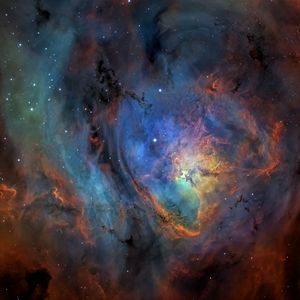
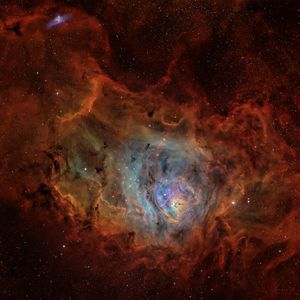
Messier 8 (M8), the Lagoon Nebula
Near the bottom-right of the image, M8 makes an appearance. It’s also catalogued as Sh2-25. The Lagoon is a giant star-forming region 5,200 light-years away in Sagittarius. It contains a large number of blazingly hot stars that ionize the gas in the nebula so that it gives off its own light. This nebula is so bright it can be seen with the naked eye under very dark skies.
To us here on Earth, the Lagoon appears to be more than three times the size of the full moon. It’s dimensions are roughly 140 by 60 light years.

Just above the Lagoon is the lesser-known Sh2-28. It is large, but much fainter than the gasses from the surrounding Trifid and Lagoon nebulas. Estimates place it at a distance of 4,900 light years.


Telescope

Takahashi FSQ106
Finding Chart

Click to expand
Image Capture
Location:
Deep Sky West
Camera:
Total integration: 6h 1m
Integration per filter:
- R: 27m (27 × 60")
- G: 27m (27 × 60")
- B: 27m (27 × 60")
- O3: 4h 40m (56 × 60")
Coordinates: 18h 6m 21s · -23° 2′ 51″
Moravian C3-61000


Astrobin Top Pick Nomination
Awards