A Trifle and a Cross – Messier 20, the Trifid Nebula and Messier 21, Webb’s Cross
September 22, 2025
Use mouse wheel to zoom, drag to pan, and buttons for other options
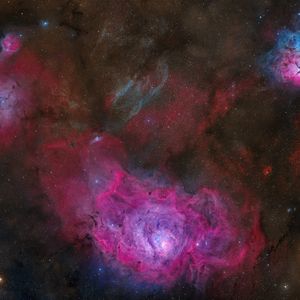
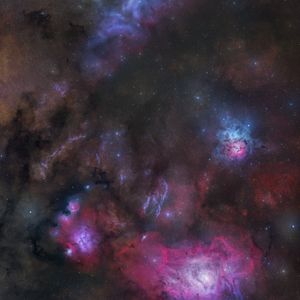
Messier 21 (M21) at the top of the frame was one of the last targets I needed to shoot to have passable images of every Messier object in the sky. It’s one of what I generally refer to as a boring “cluster Chuck” (referring to Charles Messier). M21 is an open star cluster (a group of stars that were likely born together at around the same time but are not gravitationally bound) that is about eight million years old. The cluster resides in the Sagittarius constellation approximately 4,250 light years away.
The name Webb’s Cross comes from the 1859 book Celestial Objects for Common Telescopes written by influential English amateur astronomer Rev. Thomas William Webb.
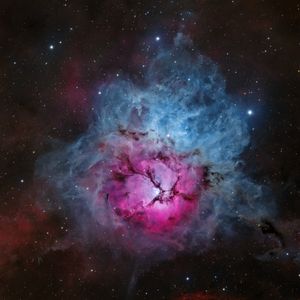
If Messier 31, the Andromeda Galaxy, is the Stairway to Heaven and Messier 42, the Great Orion Nebula, is the Don’t Stop Believin’, then Messier 20 (M20), the Trifid Nebula (at the bottom of the frame), is the Afternoon Delight of amateur astrophotographers. A prolific star-forming region roughly 5,000 light years from Earth, the Trifid gets its name from its three prominent blue lobes.
The Trifid is both a reflection nebula illuminated by nearby stars as well as an emission nebula that generates its own light from ionized gasses. It also contains dark absorption nebula lanes that contribute to its name because they divide the main body into three parts. This rendering shows it in true color. It’s what you might see if your eyeball were 20 stories tall and you could stare at it for 20 hours without blinking.
On the upper-left corner of the Trifid, the red hydrogen emission material is catalogued as Sh2-30, although Sh2-30 is often used to characterize the entire Trifid Nebula.


Telescope

Takahashi TOA130
Finding Chart

Click to expand
Image Capture
Location:
Deep Sky West
Camera:
Total integration: 29h
Integration per filter:
- Lum: 9h 30m (190 × 180")
- R: 6h 30m (130 × 180")
- G: 6h 30m (130 × 180")
- B: 6h 30m (130 × 180")
Coordinates: 18h 3m 21s · -22° 48′ 21″
Moravian C5a-100M

Awards