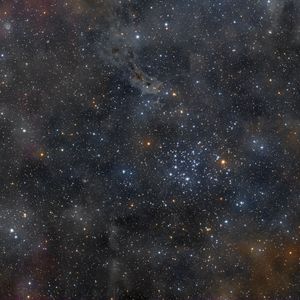
Messier 50 (M50) – Wide Field Wonderland
March 10, 2025
Use mouse wheel to zoom, drag to pan, and buttons for other options
This area in Monoceros just north of the famous Seagull Nebula (IC 2177) contains a very diverse set of fascinating objects and has been fertile ground for discoveries made by amateur astronomers. The main image displayed above is a combination of true color and false color narrowband.
Messier 50 (M50)
The most notable, and yet least interesting, of these objects is Messier 50 (M50), an open star cluster visible in the lower right corner of the image. Located about 2,900 light years away, it is often called the Heart-Shaped Cluster. It contains approximately 200 stars and is thought to be around 78 million years old.
Open star clusters (or “open clusters”) are collections of stars—perhaps a few dozen to a few thousand—that likely formed in the same molecular cloud but are not gravitationally bound to each other. They eventually wander away from each other and find their own paths through the galaxy. Our own sun was probably once part of an open cluster at one time but has since moved out on its own.

Sh2-286
Near the upper-left corner of the image, you can see the small emission nebula Sh2-286. Part of the much larger star-forming complex in Monoceros, Sh2-286 lies at a distance of about 21,500 light years.

Sh2-287
Moving down the left side of the image, you can find Sh2-287—a much more interesting red and orange emission nebula interspersed with cold, dark dusty lanes and bordering on a pink, blue, and brown reflection region. Sh2-287 is associated with Maddalena’s Cloud, a cold, dark formation rich in carbon monoxide, discovered in 1985 by Ronald Maddalena and Patrick Thaddeus. Sh2-287 is much closer to Earth than Sh2-286 at an estimated distance of 6,800 light years.

Fal Object 1
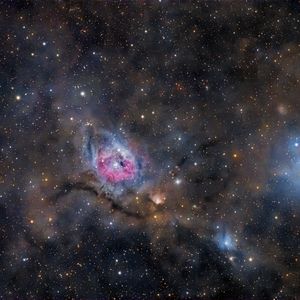
Dominating the center of the frame is the large, elliptical region filled with blue and pink hues created by ionized oxygen gas catalogued as Fal Object 1. Amateur astronomer Bray Falls discovered the formation, which he calls the Kyber Crystal Nebula, in 2023. As yet, it remains unclassified. It could be a Strömgren sphere, a planetary nebula, or even a supernova remnant (although one might expect it to contain thin filaments in that case). Time (and spectra) will tell.

Sh2-291
Another member of the Sharpless Catalogue, Sh2-291 is an emission nebula approximately 28,000 light years away. The object looks quite small in the frame, but at the aforementioned distance, and with an angular size of 9.4 arcminutes from our point of view, it would be quite large at 77 light years in diameter—three times the size of the Great Orion Nebula (Messier 42).
One interesting thing in the area around Sh2-291 is the presence of V* EM Mon—a carbon star just above (east) of the nebula. A carbon star is typically an older, cooler giant star where the concentration of carbon dredged up from its core into its atmosphere exceeds the amount of oxygen in the atmosphere. This causes carbon monoxide and other carbon compounds to form in the atmosphere giving the star a deep red color. Carbon stars are rare, comprising less than 1% of the stars in the Milky Way.

Thommes Nebula & RNO 78 in LBN 1022
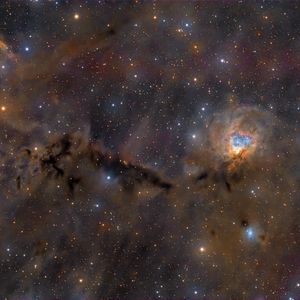
In 2009, amateur astronomer (and super nice guy) Jim Thommes discovered a bright spot about 4,200 light years away inside the nebula LBN 1022. That bright area was not present on photographic plates from the 1960s. Subsequent surveys and academic papers have revealed that it has continued to get brighter over time.
Thommes Nebula is just adjacent to RNO 78—a reflection nebula catalogued in 1980 by Martin Cohen in the survey called Red and Nebulous Objects [RNO] in Dark Clouds.
The larger formation surrounding the two small reflection nebulas is LBN 1022 from Beverly Lynd’s 1965 Catalogue of Bright Nebulae. The dark dust lanes in LBN 1022 were also catalogued by Lynd as LDN 1655 and 1666 in her 1962 Catalogue of Dark Nebulae.

NGC 2313 & NGC 2316
Barely visible in the image is the small combination reflection-emission nebula NGC 2313, which sits roughly 4,100 light years from Earth.
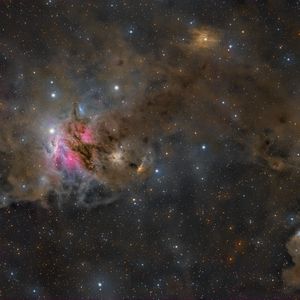
Below it is the much more prominent NGC 2316, another nebula with both reflection and emission properties. At an estimated distance of 4,200 light years, NGC 2316 also shows characteristics of a hub-filament structure where dark lanes extend from a bright central area.

PNG 221.0-01.4
PNG 221.0-01.4, also catalogued as PHR J0701-0749, is a small planetary nebula about 9,600 light years from our solar system. This one is indeed much smaller than Sh2-291 at only 3.13 light years in diameter.

StDr 44
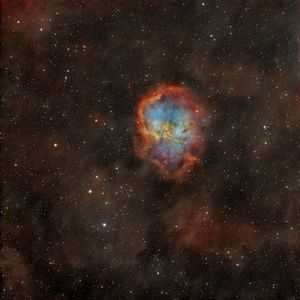
StDr 44 is a candidate planetary nebula the amateur team of Marcel Drechsler and Xavier Strottner discovered in 2020. That team has been extremely prolific over the years racking up 170 planetary nebula or potential planetary nebula discoveries together and many more with other people.

vdB 87
The 87th entry on Sydney van den Bergh’s list of reflection nebulas is one of my favorite in the entire vdB Catalogue. It’s thought to be about 2,900 light years away and exhibits properties of both reflection nebulas, and also emission nebulas. This object is very rarely photographed, and generally when it is, it doesn’t involve long total exposure times. But what I see in the data is strong red and blue signals in broadband as well as a strong presence in Ha narrowband, which leads me to the conclusion that it has properties of both kinds of nebulas.

As I mentioned above, the main image combines both true color (broadband) and false color (narrowband). But if you play the slideshow, you’ll also see the true-color-only image.


Telescope

Takahashi FSQ106
Finding Chart

Click to expand
Image Capture
Location:
Deep Sky West
Camera:
Total integration: 75h 38m
Integration per filter:
- Lum: 13h 3m (261 × 180")
- R: 7h (140 × 180")
- G: 7h (140 × 180")
- B: 7h (140 × 180")
- Hα: 14h (168 × 300")
- S2: 13h 45m (165 × 300")
- O3: 13h 50m (166 × 300")
Coordinates: 6h 58m 57s · -6° 47′ 56″
Moravian C3-61000


Astrobin Top Pick
Awards