
Buckminsterfullerine with Salt & Peppa (the Buckeyball Supernova Remnant and Messier 37)
March 31, 2025
Use mouse wheel to zoom, drag to pan, and buttons for other options
These two objects in apparent proximity to each other show how stars can be born and how they can die.
Messier 37 – The Salt & Pepper Cluster
Messier 37 (M37), commonly called the Salt & Pepper Cluster, is the open star cluster in the upper-left corner of the image. It’s about 4,500 light years from Earth and has a membership of around 500 stars.
Open star clusters (or “open clusters”) are collections of stars—perhaps a few dozen to a few thousand—that likely formed in the same molecular cloud but are not gravitationally bound to each other. They eventually wander away from each other and find their own paths through the galaxy. Our own sun was probably once part of an open cluster at one time but has since moved out on its own.
M37 contains the planetary nebula IPHASX J055226.2+323724, which makes it one of only three open star clusters in our galaxy that is known to contain a planetary nebula. It’s considered to be one of the oldest known visible planetary nebulas with an age of around 70,000 years. The planetary nebula is visible in the image as the bright-red mass on the left (east) side of the cluster.
The name “planetary nebula” is a misnomer. Planetary nebulas have nothing to do with planets. Astronomers in the 18th century thought these objects were planets, but now we know differently. When a star with 80% to eight times the sun’s mass begins to run out of hydrogen fuel, it starts fusing helium into heavier elements such as carbon and oxygen. As it does this, the additional energy from those stepped-up levels of fusion cause it to expel its outer layers.
Ultimately, the star expels all its outer layers from its core, leaving the core exposed in sort of a cosmic burp. Once all the helium is burned up, fusion ceases in the core and what is left is a giant, dense ball of carbon and oxygen (about the size of the earth, but with the mass of the sun)—a diamond in the sky called a “white dwarf.” That core no longer produces new energy, but it’s still extremely hot and gives off copious amounts of radiation, ionizing the gas it expelled earlier. That cloud of gas then eventually dissipates. But before it does, the ionized gas gives off light we can record here on earth with our cameras (if the star is close enough to us).
The Buckeyball Supernova Remnant
Twice as far away as M37, the Buckeyball supernova remnant (lower right), G179.0+2.6, dominates the frame. First detected in 1986 as a presumed galactic radio source, it has later been confirmed as a supernova remnant with an apparent size of 70 arcminutes. The distance has been estimated at between 11,000 to 14,000 light years from us, so by my possibly faulty calculations, it has an actual size of between four and five light years. The explosion that created it is thought to have occurred around 50,000 years ago.
The title is not only a reference to the famous carbon molecule named after Buckminster Fuller's geodesic domes, but also Patrick Stewart's enthusiastic introduction of SNL's musical guest:




Telescope

Takahashi TOA130 - Deep Sky West
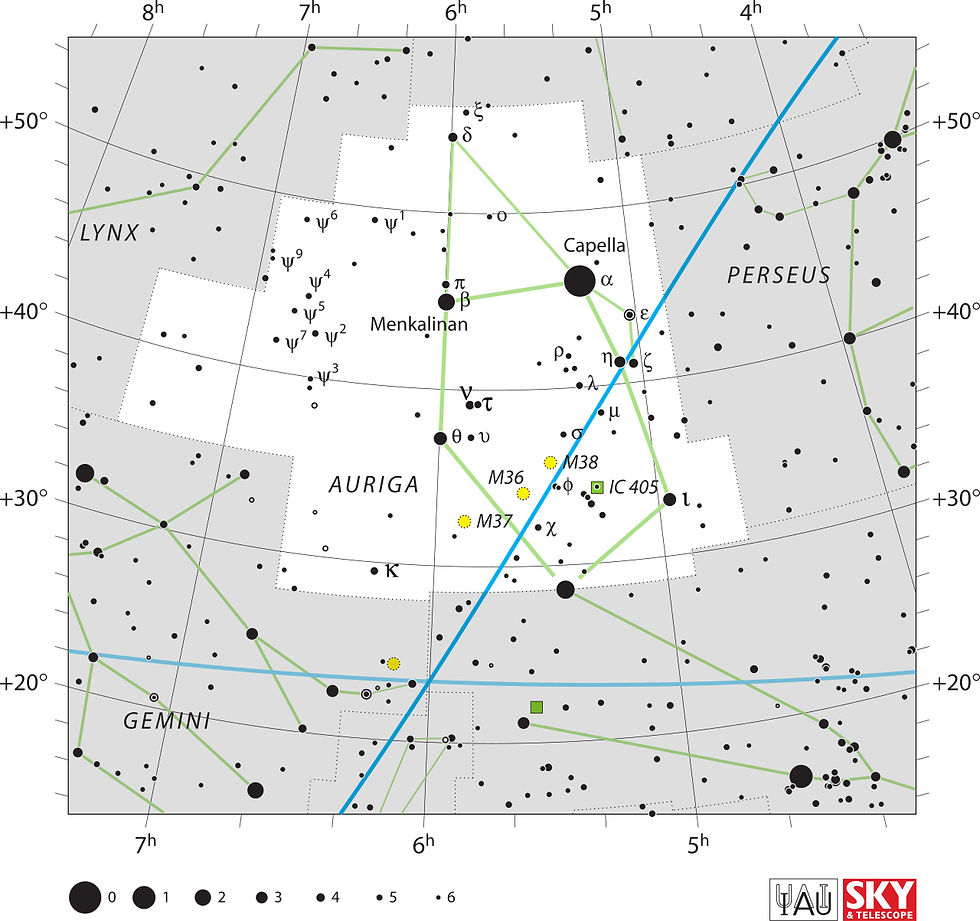
Finding Chart

Click to expand
Image Capture
Location:
Deep Sky West
Camera:
Total integration: 53h 5m
Integration per filter:
- R: 3h 45m (75 × 180")
- G: 3h 45m (75 × 180")
- B: 3h 45m (75 × 180")
- Hα: 14h 0m (158 × 300")
- O3: 27h 50m (334 × 300")
Coordinates: 5h 53m 12s · +31° 34′ 18″
Moravian C5a-100M


Astrophotography Prize Highly Commended
Awards
