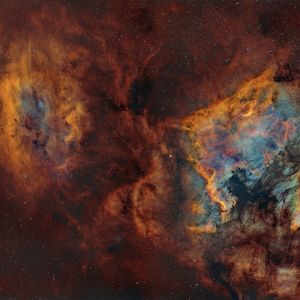
The Cygnus Wall in the North America Nebula
September 16, 2022
Use mouse wheel to zoom, drag to pan, and buttons for other options
The North America Nebula (catalogued as NGC 7000, Sh2-117, and Caldwell 20) is a large emission region actively forming new stars about 1,800 light years away. It gets its name from German astronomer Max Wolf who took the first long-exposure image of it and gave it that name because of its shape looked like the North American continent to him.

North America contains a panoply of interesting features. One of the most noticeable is the Cygnus Wall—an ionization front on the “west coast” of the “continent” that mimics the appearance of Baja California. The Wall borders on a dark nebula, LDN 935, that astronomers, without irony, call the Gulf of Mexico (there’s no such place in this universe as the “Gulf of America” except in the dementia-addled mush-brain of a certain orange sociopathic narcissist).
The Wall has no separate catalogue designation, but it’s a favorite target of amateur astrophotographers because of its interesting chemistry that produces an amazing palette of colors. The closest it comes to having been catalogued separately is the designation LBN 354, which only encompasses about half of it.


Telescope

Celestron 1100 EdgeHD
Finding Chart

Click to expand
Image Capture
Location:
Back yard in North Dallas
Camera:
Total integration: 26h 5m
Integration per filter:
- R: 17m 30s (35 × 30")
- G: 18m (36 × 30")
- B: 17m 30s (35 × 30")
- Hα: 8h 48m (176 × 180")
- S2: 8h 18m (166 × 180")
- O3: 8h 6m (163 × 180")
Coordinates: 20h 59m 21s · +43° 38′ 1″
ZWO ASI6200MM-Pro

Awards