The North America (NGC 7000, Sh2-117 & Caldwell 20), Clamshell (Sh2-119), and Pelican (IC 5070) Nebulas
September 16, 2022
Use mouse wheel to zoom, drag to pan, and buttons for other options
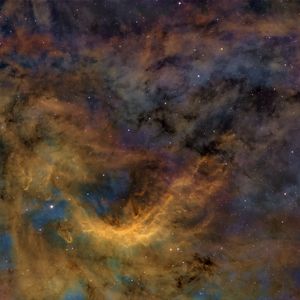
For amateur astrophotographers in the Northern Hemisphere, the Cygnus constellation is a summer wonderland. In the middle region of Cygnus, you can find the well-known North America (center) and Pelican Nebulas (right). Lesser known, yet very nearby sits the Clamshell Nebula (left). This is a two-panel mosaic that shows a bit more expansive area than you normally see.
North America Nebula
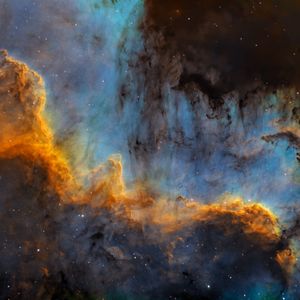
The North America Nebula (catalogued as NGC 7000, Sh2-117, and Caldwell 20) is a large emission region actively forming new stars about 1,800 light years away. It gets its name from German astronomer Max Wolf who took the first long-exposure image of it and gave it that name because of its shape looked like the North American continent to him.

North America contains a panoply of interesting features. One of the most noticeable is the Cygnus Wall—an ionization front on the “west coast” of the “continent” that mimics the appearance of Baja California. The Wall borders on a dark nebula, LDN 935, that astronomers, without irony, call the Gulf of Mexico (there’s no such place in this universe as the “Gulf of America” except in the dementia-addled mush-brain of a certain orange sociopathic narcissist).

Traveling “northeast,” you can find the Hudson Bay and Bird Nest features. Some sources list LDN 935 as the location of this feature, but most agree that it is the semicircular emission front much farther to the “north.” The Bird Nest comprises wispy dark filaments filled with the “eggs” from and open star cluster catalogued as NGC 6996
Hudson Bay (left) and the Bird Nest (right)
Pelican Nebula
Roughly 1,800 light years away, the Pelican Nebula (IC 5070) is a star-forming region comprising ionized gas powered by the stars it gave birth to. About 30 light years wide, it’s separated visually from the North America Nebula by cold, dark foreground dust (LDN 935) that gobbles up the light of stars and emission material behind it.

If you zoom in on the head of the Pelican, you’ll find a pillar of dark gas pointing to the left. At the head of that pillar, you can see two faint perpendicular jets catalogued as Herbig-Haro 555. I have a much more detailed image of this area that I will post in the fullness of time. Herbig-Haro objects are areas of bright nebulosity created by jets from newly formed stars.

One other feature that is closely associated with the Pelican is what I call the Baby Pelican. Others have referred to it as the Lizard Head. But I prefer to think of it as a pelican chick waiting for its mother to feed it.
The left eye of the Baby Pelican is the close binary pair 57 Cygni. That star system is only about 500 light years away, while the material of the Baby itself is likely at a similar distance as its mother—1,800 or so light years from us.

Clamshell Nebula
The Clamshell Nebula (Sh2-119 on the left side of the frame) is a little farther away at around 2,300 to 2,800 light years according to the most recent estimate I could find. One of the main ionizing stars, 68 Cygni, may actually be a runaway star that originated in the Cepheus constellation 5.2 million years ago.
The Clamshell is likely a Strömgren sphere. A Stromgren sphere is a cloud of gas surrounding a hot, ionizing star or stars. The cloud usually has a distinct boundary and typically appears in roughly circular form.

The Dick Tracy Nebula
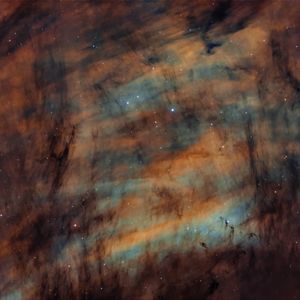
What I refer to as the Dick Tracy Nebula (IC 5068) actually goes by the names the Forgotten Nebula or the Forsaken Nebula. Located below the Pelican in the frame, the distance to Dick Tracy was long thought to be approximately 1,600 light years, but some sources list it as closer to 2,500 light years using data from the Gaia mission. The cause of its striated pattern is not well documented, but it could be the result of stellar winds (the giant star Deneb is nearby), gravitational fields, and gravitational collapse.
In any case, the form of the nebula really evokes the image of a profile of the iconic detective with his fedora and chiseled features (the crop below is rotated 180 degrees):


Telescope

William Optics ZenithStar 61
Finding Chart

Click to expand
Image Capture
Location:
Back yard in North Dallas
Camera:
Total integration: 42h 30m 30s
Integration per filter:
- Lum/Clear: 9h 18m (186 × 180")
- R: 45m (90 × 30")
- G: 42m 30s (85 × 30")
- B: 45m (90 × 30")
- Hα: 13h 33m (271 × 180")
- S2: 13h 21m (267 × 180")
- O3: 13h 24m (268 × 180")
Coordinates: 21h 7m 4s · +43° 54′ 10″
ZWO ASI6200MM-Pro

Awards

-C11-Home-2022-09-Reprocess-2026-SHO/150_The%20Pelican%20Nebula%20(IC%205070)-C11-Home-2022-09-Reprocess-2026-SHO.jpg)