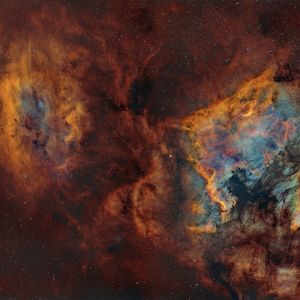
The Pelican Nebula (IC 5070) – A Mother and her Chick
September 12, 2022
Use mouse wheel to zoom, drag to pan, and buttons for other options
Roughly 1,800 light years away, the Pelican Nebula (IC 5070) is a star-forming region comprising ionized gas powered by the stars it gave birth to. About 30 light years wide, it’s close to the North America Nebula and separated visually from it by cold, dark foreground dust (LDN 935) that gobbles up the light of stars and emission material behind it.
If you zoom in on the head of the Pelican, you’ll find a pillar of dark gas pointing to the left. At the head of that pillar, you can see two faint perpendicular jets catalogued as Herbig-Haro 555. Herbig-Haro objects are areas of bright nebulosity created by jets from newly formed stars.

One other feature that is closely associated with the Pelican is what I call the Baby Pelican. Others have referred to it as the Lizard Head. But I prefer to think of it as a pelican chick waiting for its mother to feed it.
The left eye of the Baby Pelican is the close binary pair 57 Cygni. That star system is only about 500 light years away, while the material of the Baby itself is likely at a similar distance as its mother—1,800 or so light years from us.


Telescope

Celestron 1100 EdgeHD
Finding Chart

Click to expand
Image Capture
Location:
Back yard in North Dallas
Camera:
Total integration: 10h 46m
Integration per filter:
- R: 22m (44 × 30")
- G: 21m (42 × 30")
- B: 21m (42 × 30")
- Hα: 3h 18m (66 × 180")
- S2: 3h 15m (65 × 180")
- O3: 3h 9m (63 × 180")
Coordinates: 20h 52m 27s · +44° 16′ 36″
ZWO ASI6200MM-Pro

Awards