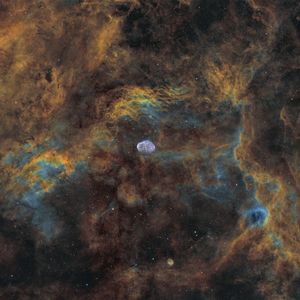
The Manatee Nebula – LBN 251 (IC 1318A)
September 23, 2022
Use mouse wheel to zoom, drag to pan, and buttons for other options
Some refer to this nebula as the Longhorn Nebula. Looking at a 180-degree rotation of it, I can see why:

Still others say it reminds them of a cat pouncing. As for me, in the orientation I chose to shoot it, I see a lumbering manatee swimming through cosmic waters.
Distance estimates on the web are all over the place ranging from 1,800 to 5,000 light years. The most authoritative source I could find was a 1978 paper from Cantó, et al, placing it at approximately 1.5 kiloparsecs, or 4,900 light years, from Earth.
I can’t find a lot of research on this area. But one thing that did pique my interest was a 2019 notice from Pogrosheva, et al, that identified a MASTER OT nearby (see annotation overlay for its location). What the hell is a MASTER OT, you ask? Good question, and until yesterday, I had no clue. Sadly, it turns out that it’s not Victor Wembanyama in a double-overtime Western Conference Final game.
MASTER stands for Mobile Astronomical System of Telescope Robots. It’s a system of telescopes around the world that are constantly on the lookout for sudden changes in the night sky called OTs—optical transients. The initial idea was to look for gamma-ray bursts, which are thought to be the most powerful explosions in the universe and are detectable only for a short time.
Gamma-ray bursts were discovered in the 1960s quite by accident. The U.S. Air Force had launched satellites to look for radiation signatures that would identify violations of the recently signed Limited Test Ban Treaty, which prohibited testing nuclear weapons in the atmosphere. These satellites began to detect signals indicative of a nuclear blast, which caused great alarm. It wasn’t until decades later that scientists learned that gamma-ray bursts from far beyond our galaxy were causing these signals. They now believe these bursts are caused by the collisions of neutron stars colliding with each other, a neutron star colliding with a black hole, or the death of an extremely large star.
Other things can also trigger a MASTER OT alert, such as X-ray outbursts, active galactic nuclei, or the accretion of matter around a black hole.
In any case, after a MASTER OT notice is sent, astronomers usually engage in immediate follow-up observations to try to learn more about the nature of the event and what caused it. This can be done by telescopes that are prioritized to track transient events, such as the Southern African Large Telescope (SALT).


Telescope

Celestron 1100 EdgeHD
Finding Chart

Click to expand
Image Capture
Location:
Back yard in North Dallas
Camera:
Total integration: 21h 54m
Integration per filter:
- R: 20m (40 × 30")
- G: 20m (40 × 30")
- B: 20m (40 × 30")
- Hα: 6h 30m (130 × 180")
- S2: 7h 57m (159 × 180")
- O3: 6h 27m (129 × 180")
Coordinates: 20h 16m 45s · +41° 51′ 23″
ZWO ASI6200MM-Pro

Awards