Cygnus Mosaic – From the Butterfly to the Tulip
September 10, 2022
Use mouse wheel to zoom, drag to pan, and buttons for other options
The Cygnus constellation is a summer wonderland for Northern Hemisphere skywatching. It’s packed with just about every kind of astronomical object we know about. Even though this mosaic comprises three panels from a wide-field refractor, it only shows a fraction of the central region of Cygnus. To capture it all would require north of two-dozen panels.
Everything you see in this image is a small part of the giant, massive Cygnus X region—an area sporting a very prolific level of star forming. It’s generally thought to be around 4,600 light years from Earth and spans around 600 light years. There’s no way I could cover everything you see in the image in detail, but I’ll hit the highlights working my way from left to right. Also note that you can click on the “eye” button in the toolbar on the image above to display an overlay that labels the significant objects in the image.
LBN 251 – The Manatee Nebula (Longhorn Nebula)
I’ve previously published a more detailed image of the Manatee that came from one of my bigger telescopes. I hope this mosaic helps you place it more in context. Look for it in the upper left of the frame. Some call this the Longhorn Nebula (you have to rotate it 180 degrees to easily see that). Distance estimates put it at approximately 1.5 kiloparsecs, or 4,900 light years, from Earth. The Manatee is an emission nebula, which means its gasses give off their own light due to ionization caused by massive hot stars in its midst.

NGC 6910 – The Inchworm Cluster
Directly below the Manatee and just above the Butterfly, the Inchworm Cluster lives. It’s an open cluster, which means that while its stars may have formed from the same gas cloud, they are only loosely bound and will likely drift apart over time. Our sun was likely born as part of an open cluster and then eventually drifted off on its own. It’s estimated to be around 5,500 light years away.

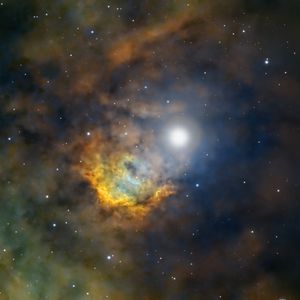
IC 1318 – Sh2-108 – The Gamma-Cygni Nebula (Butterfly Nebula)
IC 1318 is a large, nebulous emission region that surrounds the star Gamma Cygni (also known as Sadr). While often referred to as the Butterfly Nebula, that name more often describes a planetary nebula in the Scorpius constellation, NGC 6302. Nevertheless, the formation to the east of Sadr (note that in the picture, east is left and west is right), is surely reminiscent of a butterfly shape. The upper “wing” is catalogued as IC 1318B and the lower “wing” is catalogued as IC 1318C. It’s generally thought to be about 3,700 light years away.

Sadr – Gamma Cygni
Sadr is a bright star that sits at the intersection of the Northern Cross asterism (a formation of unrelated stars) about 1,800 light years from Earth.

Sadr truly is a giant. Although its surface temperature is similar to that of the sun at around 5,000 degrees Kelvin, it is 183 times larger, 14 to 16 times more massive, and shines with a luminosity 60,000 times greater. It’s not actually associated with all the nebulosity surrounding it. It’s much closer to Earth at a distance of approximately 1,830 light years.
Nevertheless, it is framed from our vantage not only against the large backdrop of the Gamma Cygni nebula, but also just above a smaller, more chemically diverse emission region that gives off multiple hues. This little area appears to be DWB 63—the 63rd entry in the Dickel, Wendker, Bieritz catalogue of visible HII (emission) regions in the Cygnus X complex. It was once thought that Sadr was the ionizing source for this small nebula, but we now know that Sadr is much closer to us than this little nebula).

Messier 29 (M29) – NGC 6913 – The Cooling Tower Cluster
M29 is a small open star cluster sitting about 7,200 light years away. Because it’s surrounded by dense gas and dust, it’s not as bright as it might otherwise be. It’s about 10 million years old and has a diameter of about 11 light years.

LBN 208 – Gothmog’s Cauldron
I included a crop of this area because it played a key role in one of my favorite images—that of Gothmog the Balrog. Depending on what filters are used and what methods are used to process it, it can look like anything from the feathers of a bird to the caldera of an active volcano.

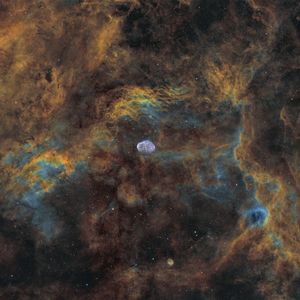
NGC 6888 – Sh2-105 – Caldwell 27 – The Crescent Nebula
What looks like a floating space brain, the Crescent is one of the most popular targets in the sky for astrophotographers. I’ve personally shot it at least eight times on six different telescopes. It’s approximately 4,700 light years away. The Wolf-Rayet star WR136 created it and continues to power it. Wolf-Rayet stars are huge, hot stars that are in the process of blowing off their outer layers. At some point, WR136 will commit stellar suicide in a supernova explosion.

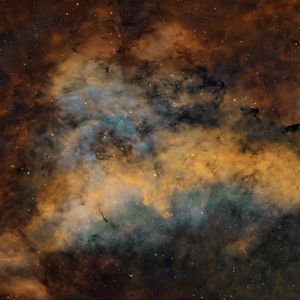
Sharpless 2-104 (Sh2-104)
It would appear that Sh2-104 is not really part of the Cygnus X complex. It’s distance estimates range from 11,350 light years to 15,650 light years. One study has found it to be a good example of the “collect and collapse” model for star formation, concluding that there are areas within it where the radiation from massive, hot stars is compressing gas into regions that are forming new stars.

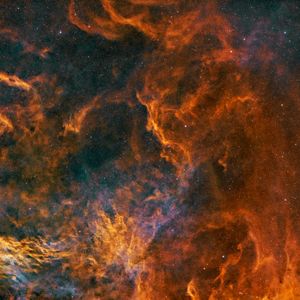
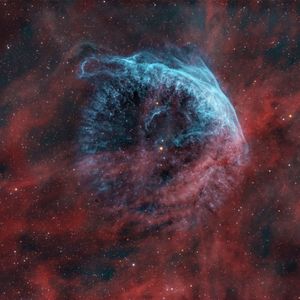
WR134 – Shai-Hulud
Shai-Hulud is the name I gave this nebula because its appearance is that of the gaping maw of a sandworm about to swallow a spice harvester. I have previously photographed this object at a much higher resolution, but once again, this mosaic allows it to be seen in the context of its surroundings. One thing that makes this image unique is that it captures two striking Wolf-Rayet artifacts at once. WR134 is approximately 5,600 light years away.

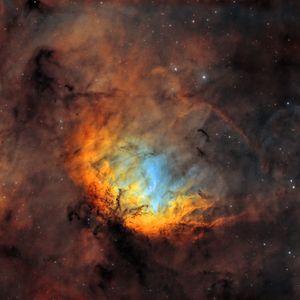
Sh2-101 – The Tulip Nebula
This is another object I’ve shot with a much larger scope. But here, it serves as a wonderful bookend for this mosaic. This is yet another object that may be beyond the reach of the Cygnus X complex and occupy its own place in the galaxy. The Tulip is about 8,750 light years from Earth, which is significantly farther than the 5,000 or so light years of space between us and Cygnus X.


Telescope

William Optics ZenithStar 61
Finding Chart

Click to expand
Image Capture
Location:
Back yard in North Dallas
Camera:
Total integration: 77h 51m
Integration per filter:
- R: 58m 30s (117 × 30")
- G: 1h (120 × 30")
- B: 1h 2m (124 × 30")
- Hα: 25h 42m (514 × 180")
- S2: 22h 51m (457 × 180")
- O3: 26h 18m (526 × 180")
Coordinates: 20h 12m 11s · +38° 12′ 14″
ZWO ASI6200MM-Pro


Astrobin Top Pick Nomination
Awards