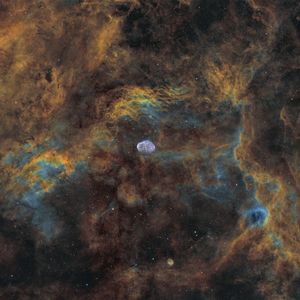
Shai-Hulud – Wolf-Rayet 134
July 1, 2022
Use mouse wheel to zoom, drag to pan, and buttons for other options
The Sandworm Nebula is the result of the activity of the star Wolf-Rayet 134 (WR 134) in Cygnus 5,600 light years away. Wolf-Rayet stars are huge, hot stars that are in the process of blowing off their outer layers. In this case, it resulted in the ring of mostly blue-green oxygen gas you see in the image.
The star responsible for this formation is catalogued as HD 191765:

When shooting objects like this, we typically use what are called “narrowband filters.” In this case, the image above was shot with two narrowband filters—one that isolates light emitted by ionized hydrogen (red), and one that isolated light emitted by ionized oxygen gas (blue-green). The representation you see above is very conventional, with results from the hydrogen filter mapped exclusively to red and the results from the oxygen filter mapped to blue and green.
But there are other ways to interpret this data visually. One way is through the use of the Foraxx palette, which dynamically maps data to the color spaces depending on the strength of the oxygen signal. This can sometime expose more of the chemistry involved in a formation and provide a different level of contrast that brings out more detail.
In this case, I also produced an image using the Foraxx palette. You can see this version by clicking on the overlay button—the eye—above in the image frame.


Telescope

Celestron 1100 EdgeHD
Finding Chart

Click to expand
Image Capture
Location:
Back yard in North Dallas
Camera:
Total integration: 17h 6m
Integration per filter:
- Hα: 5h 48m (116 × 180")
- O3: 11h 18m (226 × 180")
Coordinates: 20h 10m 20s · +36° 10′ 49″
ZWO ASI6200MM-Pro

Awards