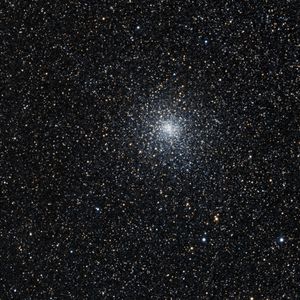
Messier 28 (M28) Wide Field
August 12, 2025
Use mouse wheel to zoom, drag to pan, and buttons for other options
Having shot more than 20 globular clusters from the Messier Catalogue with a larger telescope, I decided to go with a wide field for Messier 28 (M28) to gather a bit more context. Located about 18,000 light years away, low on my horizon, M28 was the second one discovered, in 1987, to contain a short-period pulsar—a neutron star rotating once every three milliseconds!

This field is rich in planetary nebulas (areas marked “PK” on the annotation overlay), but they are all so small they either show up only as a small dot or are too small for my small telescope to pick them up at all. But more on that later.
Sh2-35, which borders on the Small Sagittarius Star Cloud (Messier 24—out of frame to the left) makes an appearance here in the upper-left corner.

M28 Facts
Distance: 18,000 light years
Number of stars: 50,000
Diameter: 60 light years
Age: 12 billion years


Telescope

Takahashi FSQ106
Finding Chart

Click to expand
Image Capture
Location:
Deep Sky West
Camera:
Total integration: 22h 27m
Integration per filter:
- R: 24m (24×60″)
- G: 24m (24×60″)
- B: 24m (24×60″)
- Hα: 7h 15m (87×300″)
- OIII: 6h 55' (83×300″)
- SII: 7h 5m (85×300″)
Coordinates: 18h 21m 1s · -22° 46′ 8″
Moravian C3-61000

Awards