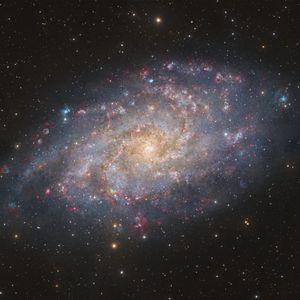
The Triangulum Galaxy and its Nebulas
November 12, 2025
Use mouse wheel to zoom, drag to pan, and buttons for other options
As discussed in the description of the image of Messier 33 (M33), the Triangulum Galaxy contains a number of star-forming regions so large, and so visible from Earth-based telescopes that they have their own NGC entries.
Obviously, I cannot achieve what the Hubble Space Telescope achieves from 400 miles above the Earth’s surface. But I’m still amazed I can do as well as this with a five-inch refractor in New Mexico.
The biggest player in this list of M33 nebulas is NGC 604—perhaps the largest known HII star-forming region. More than 50 times the size of the Great Orion Nebula in our own galaxy, it contributes to M33’s prodigious star-forming rate, which is ten times that of the much larger Andromeda Galaxy.


Telescope

Takahashi TOA130
Finding Chart
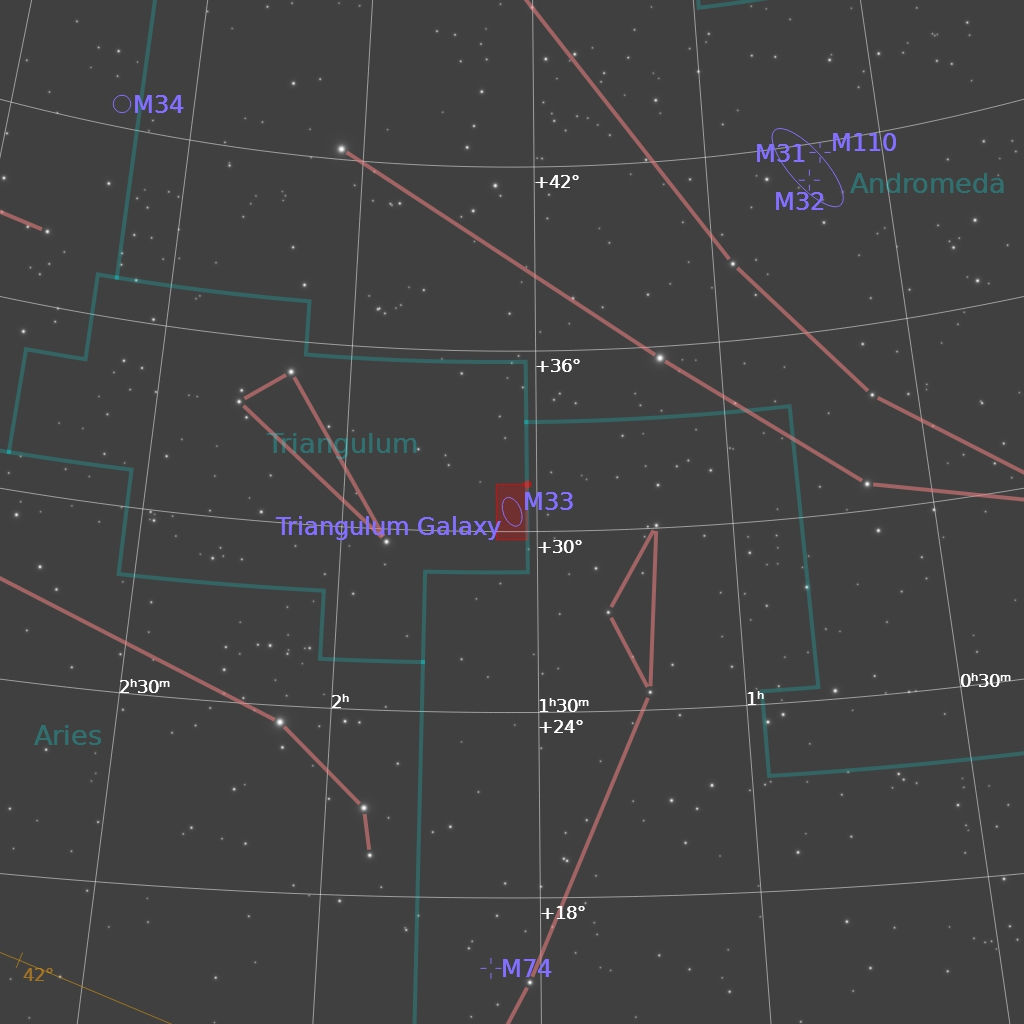
Click to expand
Image Capture
Location:
Deep Sky West
Camera:
Total integration: 200h 37m
Integration per filter:
- Lum: 11h 50m (710 × 60")
- Lum: 21h 27m (429 × 180")
- R: 5h 59m (359 × 60")
- R: 16h 18m (326 × 180")
- G: 5h 56m (356 × 60")
- G: 16h 21m (327 × 180")
- B: 5h 44m (344 × 60")
- B: 16h 30m (330 × 180")
- Hα: 7h 21m (147 × 180")
- Hα: 26h 20m (158 × 600")
- SII: 7h 33m (151 × 180")
- SII: 26h 10m (157 × 600")
- OIII: 6h 48m (136 × 180")
- OIII: 26h 20m (158 × 600")
Coordinates: 1h 33m 53s · +30° 39′ 18″
Moravian C5a-100M

Awards