
Three of a Perfect Pair – Messier (M81), Messier 82 (M82), and Holmberg IX
February 9, 2025
Use mouse wheel to zoom, drag to pan, and buttons for other options
This trio of galaxies is often photographed as a set. People mostly only pay attention to Messier 81 (M81), also called Bode’s Galaxy, and Messier 82 (M82), colloquially called the Cigar Galaxy. Hence, I chose the title above from the 1984 King Crimson album

German astronomer Johann Elert Bode discovered M81, the larger galaxy on the left, in 1774. It’s located approximately 11.6 million light years away. It has a central black hole with a mass of 70 million suns. The pink blobs in the spiral arms are large star-forming regions comprising a large amount of hydrogen gas. M81’s 90,000 light-year span is somewhat smaller than our Milky Way, which is 100,000 or so light years across. M81 is a prime example of a grand-design spiral galaxy and is a favorite target for astrophotographers.
M82, the Cigar Galaxy, on the lower right had a close encounter with the larger M81 some 600 million years ago. This is likely what turned M82 into a starburst galaxy—a galaxy with a massive amount of star formation near its center. M82 is still forming new stars at 10 times the rate of our Milky Way Galaxy. This frenzy is ejecting plumes of gas from the center of the galaxy above and below its plane.
The blue patch just above M81 is an irregular dwarf galaxy recorded under the name Holmberg IX. Scientists think Holmberg IX may be the remains of material stripped from M81 and M82 during their close interaction 600 million years ago (some estimates are closer to 300 million years).
Also present in the image, you can see wispy lanes of gray integrated-flux nebula material. Integrated flux nebulas (IFNs) are the result of extremely diffuse gas and dust at or beyond the perimeter of the galaxy reflecting the light of all the stars in the Milky Way. IFNs are very faint and are extremely hard to capture with a telescope, often requiring dozens or even hundreds of hours of exposure time to unravel.




Telescope

Planewave CDK12.5
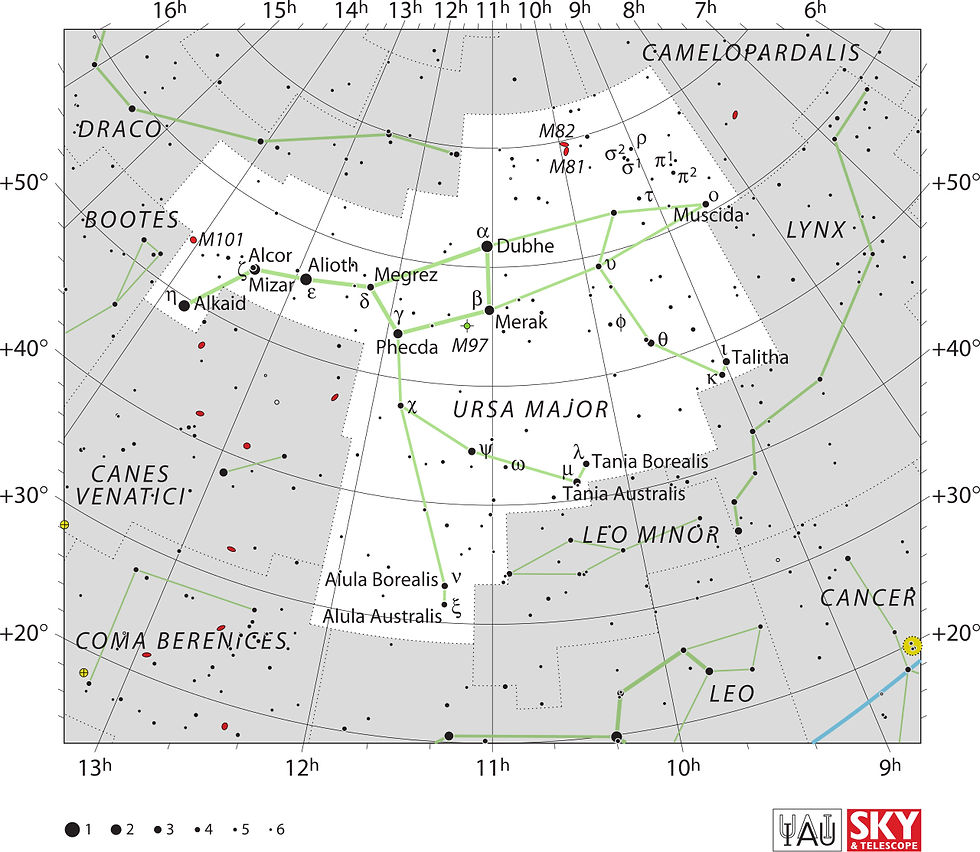
Finding Chart

Click to expand
Image Capture
Location:
Deep Sky West
Camera:
Total integration: 72h 55m
Integration per filter:
- Lum: 17h 54m (358 × 180")
- R: 12h 21m (247 × 180")
- G: 12h 21m (247 × 180")
- B: 12h 24m (248 × 180")
- Hα: 17h 55m (215 × 300")
Coordinates: 9h 55m 54s · +69° 17′ 38″
Moravian C5a-100M


Astrophotography Prize Silver

Astrobin Top Pick Nomination
Awards
