Messier 89 (M89)
April 19, 2025
Use mouse wheel to zoom, drag to pan, and buttons for other options
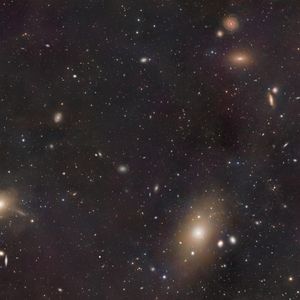
At first glance, Messier 89 (M89) looks like an amorphous blob. But there’s a lot going on there. It has more than 2,000 globular clusters orbiting its mass of 100 billion stars. Many of the “stars” you see in the image close to it may actually be globular clusters.
It also contains a complex of distinct shells that may be evidence of interaction or merger with smaller galaxies in the past. A protuberance that extends up to 100,000 light years from the galaxy’s center is, perhaps, also the result of past interactions with other galaxies. The galaxy is enveloped by a faint stellar structure extending as far as 150,000 light years from the galaxy’s center.
M89 is a member of the Virgo Galaxy Cluster and lies roughly 50 million light-years from Earth.


Telescope

Planewave CDK12.5
Finding Chart

Click to expand
Image Capture
Location:
Deep Sky West
Camera:
Total integration: 38h 12m
Integration per filter:
- Lum: 17h 3m (341 × 180")
- R: 7h 3m (141 × 180")
- G: 7h 3m (141 × 180")
- B: 7h 3m (141 × 180")
Coordinates: 12h 36m 0s · +12° 34′ 0″
Moravian C5a-100M


Astrobin Top Pick Nomination
Awards