Messier 90 (M90) and Ram-Pressure Stripping
April 19, 2025
Use mouse wheel to zoom, drag to pan, and buttons for other options
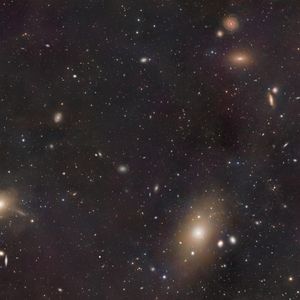
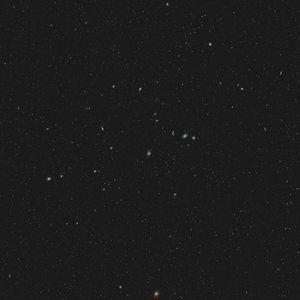
Messier 90 (M90) is a spiral galaxy in the Virgo Galaxy Cluster approximately 59 million light years away. You can see a great deal of red, ionized hydrogen gas streaming from the galaxy. This material more than 300,000 light years long and is the result of a phenomenon called ram-pressure stripping.
Galaxy clusters often contain hot, X-ray emitting gas called intra-cluster medium. As M90 speeds through this gas in the Virgo Galaxy Cluster, that gas peels away the lightweight hydrogen from the the galaxy much the same way a strong wind might blow dust off the hood of your car. This interaction causes some of that hydrogen to ionize, which makes it visible to us when we employ a special hydrogen filter and a good bit of patience and perseverance.
Ram-pressure stripping can be deadly to new star formation in a galaxy because it robs it of material from which it can create stars. But ironically, new star formation can actually be triggered by ram pressure in these gaseous tails, although I have not been able to ascertain whether that is occurring in M90’s tail.


Telescope

Planewave CDK12.5
Finding Chart
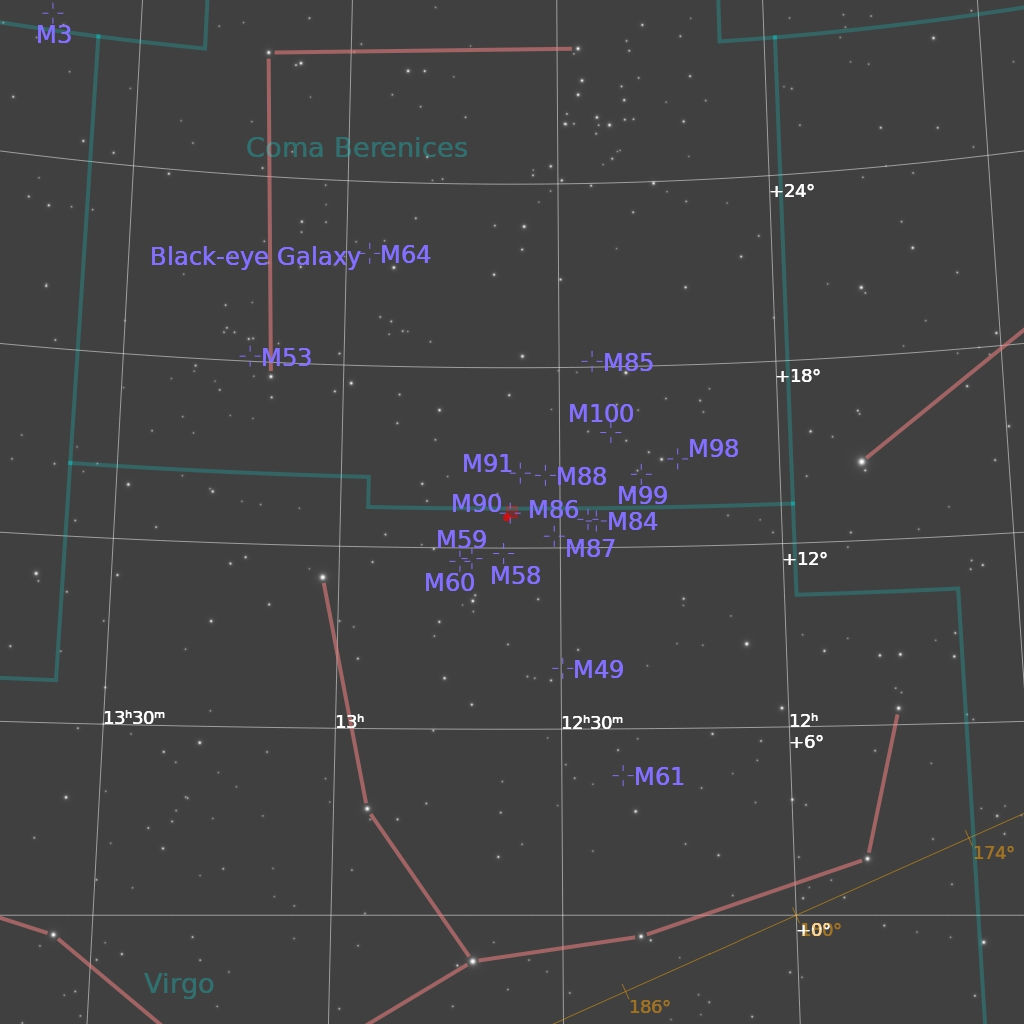
Click to expand
Image Capture
Location:
Deep Sky West
Camera:
Total integration: 126h 27m
Integration per filter:
- Lum: 17h 3m (341 × 180")
- R: 7h 3m (141 × 180")
- G: 7h 3m (141 × 180")
- B: 7h 3m (141 × 180")
- Hα: 42h 45m (513 × 300")
- Hα: 45h 30m (273 × 600")
Coordinates: 12h 36m 35s · +13° 12′ 10″
Moravian C5a-100M


Astrobin Image of the Day

NASA Sky

Astrophotography Prize Silver
Awards