Markarian’s Chain
July 7, 2025
Use mouse wheel to zoom, drag to pan, and buttons for other options
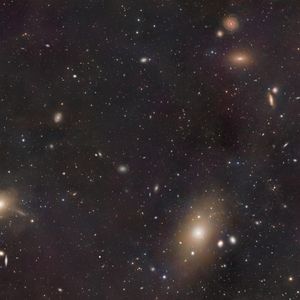
This image depicts a nice chunk of the Virgo Galaxy Cluster. Containing more than 2,000 galaxies around 30 to 50 million light years away, the Virgo Cluster exerts tremendous gravitational influence on its members and neighbors, including what astronomers call our own “Local Group” of galaxies. Current evidence suggests that eventually, the Virgo cluster will swallow up the Local Group.
The Virgo cluster is home to 16 galaxies listed in the Messier catalogue, but this image only contains three of them—Messiers 84, 86, and 87(M84, M86, and M87). The main focus of this image is a spectacular formation of galaxies called Markarian’s Chain. The Chain includes M84 and M86 (but not M87 in the lower left). It starts right of center in the image and curves upward and to the left.
Markarian’s Chain is named for Benjamin Markarian, an Armenian astrophysicist who, in 1961, discovered that the group of aforementioned galaxies shared a common motion. Just adjacent to M86 on its left are “The Eyes”—two interacting galaxies catalogued as NGC 4435 and 4438.
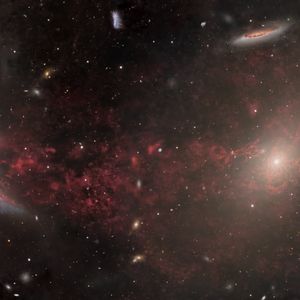
While I’m certainly not the first to expose it, one of the things that is unusual about this image is that it reveals not only red foreground emissions of hydrogen gas, likely in our own galaxy, but also what is often referred to “The Bridge” between The Eyes and M86. This was discovered in 2007 at Kitt Peak by Jeffrey Kenney and his team using the Mayall four-meter telescope. The Bridge has been characterized as tidal stripping of hydrogen from galaxies that are interacting gravitationally.
The Bridge is extremely faint. To achieve this capture required 180 hours of time on the telescope using a specialized hydrogen filter. The exposure time for the rest of the image, however, still amounted to more than 220 hours, making this one of my most arduous projects.
I'm grateful to Steve Mandel for putting me in contact with Dr. Adolf Witt at the University of Toledo who went to great lengths to help me verify that the burgundy color you see in the background is really there and not just an artifact of the photographic process.
It represents a phenomenon called extended red emission (ERE). ERE tends to occur when particles of polycyclic aromatic hydrocarbons fluoresce with a deep red color due to the presence of ultraviolet radiation from nearby stars. This differs from hydrogen material emitting its own red light due to ionization—as in the Bridge or in emission nebulas.
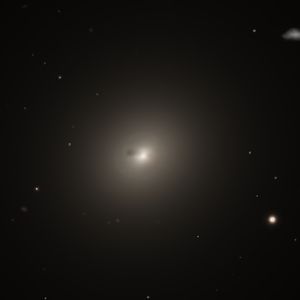
Finally, this image includes the (relatively) famous galaxy Messier 87 (M87). It’s the large elliptical galaxy toward the lower left. M87 is gigantic—containing several trillion stars (compared to a few hundred billion in the Milky Way) and around 15,000 globular clusters (compared to somewhere north of 100 orbiting our galaxy). M87 is famous for the jet of synchrotron radiation emanating from its central black hole (not visible in this image).
But M87 is even more famous for having given up the very first image ever taken of a black hole—a black hole that has 6.5 billion times the mass of our sun (compared to the Milky Way’s central black hole that weighs in at a paltry four million suns). In 2017, the Event Horizon Telescope (EHT) Collaboration released an image of M87’s central black hole (called M87*) using data gathered from radio telescopes around the world. The technique the EHT team used with telescopes located all over the planet effectively turned the Earth into a giant radio telescope able to resolve the core of a galaxy 50 million light years away.


Telescope

Takahashi TOA130
Finding Chart

Click to expand
Image Capture
Location:
Deep Sky West
Camera:
Total integration: 400h 18m
Integration per filter:
- Lum: 45h (900 × 180")
- R: 25h 15m (505 × 180")
- G: 25h 3m (501 × 180")
- B: 25h (500 × 180")
- Hα: 147h 20m (442 × 1200")
- Hα: 132h 40m (1592 × 300")
Coordinates: 12h 26m 51s · +13° 0′ 7″
Moravian C5a-100M


NASA Sky

Astrobin Top Pick Nomination
Awards