
Messier 108 (M108) - The Surfboard Galaxy
December 27, 2020
Use mouse wheel to zoom, drag to pan, and buttons for other options
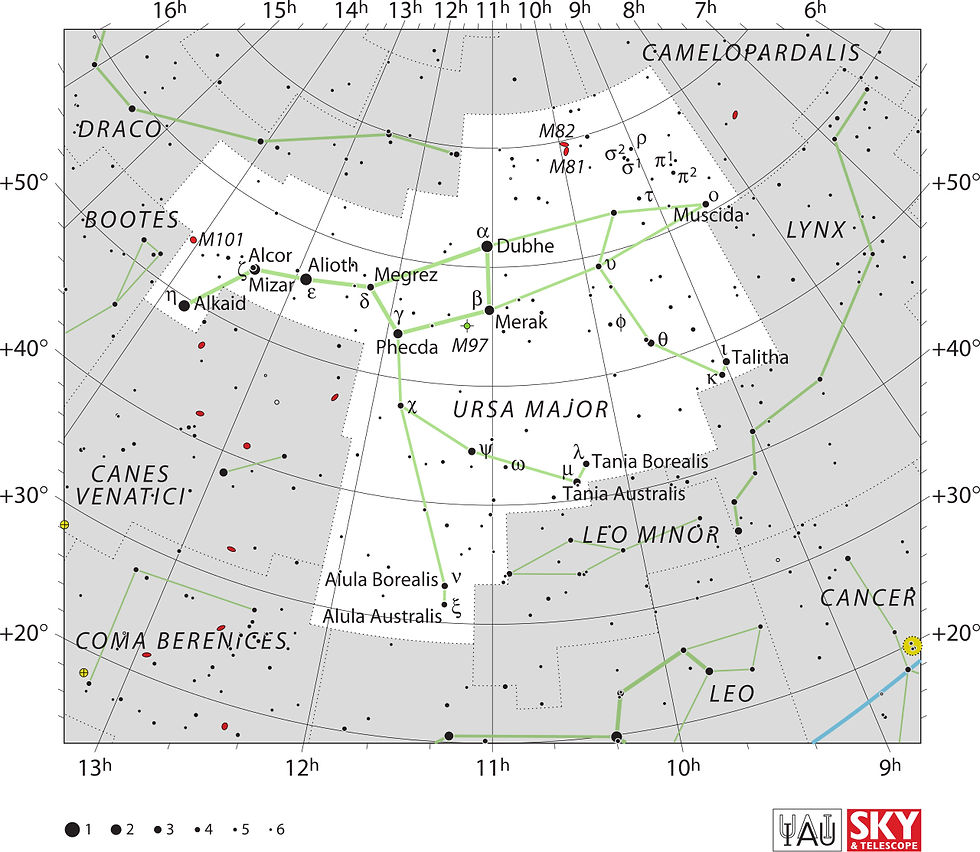
In Ursa Major, near the Big Dipper’s bowl, the Surfboard Galaxy, M108, resides. It’s approximately 45 million light years away from us and is moving away from us at 1.7 million miles per hour. Note that even at that extreme speed, it will take it 3.5 million years to add a single light year to that distance.
Its name comes from the fact that we are viewing it almost edge on and see no perceptible bulge. Pierre Méchain discovered in 1781 and later confirmed by Messier. But neither of them recorded its position, so it wasn’t initially an entry in the Messier Catalogue. Astronomer Owen Gingerich added it in 1953.
It has a mass of around 125 billion suns and is roughly the same size as our Milky Way Galaxy at 100,000 to 110,000 light years across. At its center, it sports a black hole with a mass of 24 million suns—six times larger than the black hole at the center of our galaxy.
One strange thing about it is that it contained a water maser that vanished. A maser is similar to a laser, but instead of emitting visible light, a maser emits microwaves. A water maser occurs when water molecules are excited by high-energy radiation, such as the accretion disk of a black hole, a supernova explosion, or even a large star. The water molecules then amplify that radiation resulting in a water maser. Water masers are fairly common in the universe. What is unusual is for them to suddenly disappear like the one in M108 did.




Telescope

Celestron 1100 EdgeHD
Finding Chart

Click to expand
Image Capture
Location:
Back yard in North Dallas
Camera:
Total integration: 3h 40m
Integration per filter:
- Optolong L-Pro: 3h 40m (110 × 120")
Coordinates: 11h 11m 31.458s · +55° 40′ 31.41″
ZWO ASI2400MC-Pro

Awards
