
Messier 9 (M9)
August 11, 2021
Use mouse wheel to zoom, drag to pan, and buttons for other options
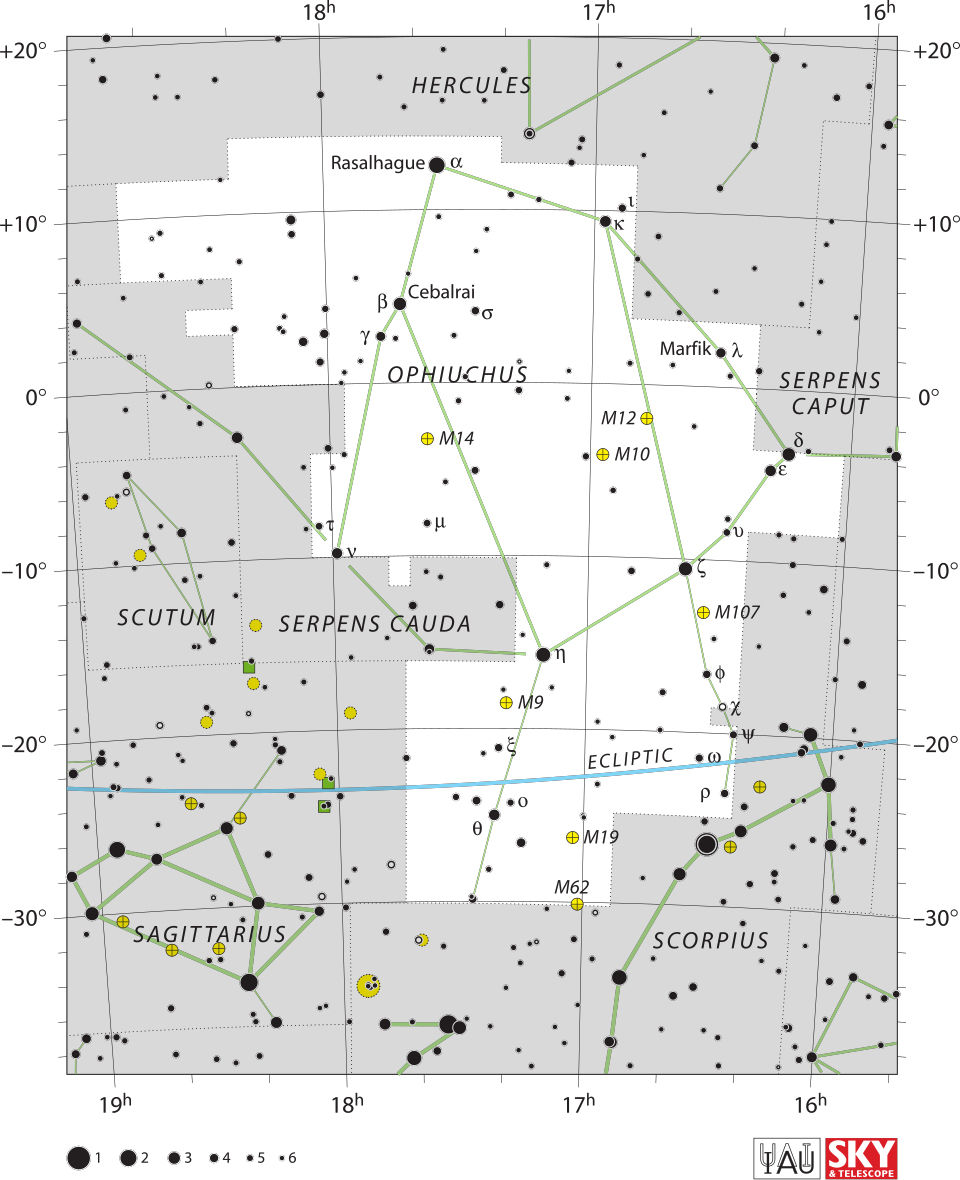
Messier 9 (M9) is a globular cluster located in the Ophiuchus constellation. It’s one of the nearer globular clusters at a distance of only about 25,000 light years.
It’s also one of the globular clusters that is closest to the core of our galaxy at a distance of only 5,500 light years from the center. Unlike most globular clusters, which are spherical in shape, M9 is slightly flattened due to its proximity to the strong gravitational forces at the center of the galaxy.
This frame also contains a hint of Lynd’s Dark Nebula 175 (LDN 175) to the right of the cluster. These dark clouds are made up primarily of hydrogen with oxygen, carbon, and other elements also present.
Globular clusters are ancient. They are many billions of years old—usually 10 to 13 billion years old—almost as old as the universe itself. The stars they contain tend to be very old as well, because star formation inside the cluster has largely ceased. The formation of globular clusters is not well understood. Current research leans toward the idea that they formed from very dense molecular clouds in the early universe. Some larger globular clusters may once have been dwarf galaxies whose larger star populations were stripped away from the core by larger galaxies.
M9
Distance: 25,800 light years
Number of stars: 250,000
Diameter: 90 light years
Age: 12 billion years




Telescope

Celestron 1100 EdgeHD
Finding Chart

Click to expand
Image Capture
Location:
Back yard in North Dallas
Camera:
Total integration: 1h 24m
Integration per filter:
- Optolong L-Pro: 1h 24m (42 × 120")
Coordinates: 17h 19m 12s · -18° 30′ 53″
ZWO ASI2400MC-Pro

Awards
