Rho Ophiuchi Cloud Complex
May 29, 2023
Use mouse wheel to zoom, drag to pan, and buttons for other options
One of the most compelling scenes in the deep sky is the Rho Ophiuchi Cloud Complex. Shot here in true color, it’s the closest star nursery to Earth at a distance of 390 light years. Its multicolored hues are due to the presence of stars of varying sizes and colors, hydrogen, polycyclic aromatic hydrocarbons, and other compounds that reflect or scatter the light of those stars in different ways.
Antares Nebula (vdB 107, IC 4606, LBN 1107)
The most prominent star in the frame is Antares (α Scorpii, the brightest star in the Scorpius constellation), which lies at the center of the yellow-orange cloud near the center of the image. Antares is approximately 550 light years away and illuminates the Antares Nebula from behind. It has a mass of 12 to 15 times that of our sun and with a diameter 700 times the sun’s diameter, it is one of the largest known stars.

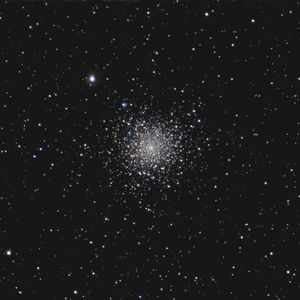
NGC 6144
NGC 6144 is one of three globular clusters in the image. Although it looks like it is embedded in the Antares Nebula, it is actually much farther away at a distance of approximately 26,500 light years. The Antares Nebula obscures a lot of its detail in the image, but it contains around 85,000 stars and has a diameter of roughly 80 light years. It’s a very old globular cluster with an age of around 13.8 billion years.

Messier 4
Messier 4 (M4) is the closest known globular cluster to our solar system at a distance of just 5,500 light years. M4 contains more than 20,000 stars inside a radius of about 35 light years and is approximately 12.2 billion years old. You can see it in the image almost directly above Antares.
Early in its tenure (in 1995), the Hubble Space Telescope discovered a number of white dwarf stars in the cluster that would be among the oldest stars in our galaxy. But in 2003, the Hubble team made an even more astonishing discovery—the oldest known planet. Between 12 and 13 billion years old, the planet is two-and-a-half times the size of Jupiter and orbits an odd binary pair comprising a pulsar (PSR B1620-26) and a white dwarf star. The planet has a catalogue designation of PSR B1620-26 b and is called Methuselah.

Messier 80
Messier 80 (M80) is in the upper left corner of the frame. Lying 32,600 light years away, M80 hosts more than 200,000 stars in an area 96 light years in diameter. At an age of around 12.54 billion years, M80 is one of the densest known globular clusters and contains twice as many blue straggler stars as most other globular clusters that scientists have studied. Blue stragglers are stars that appear brighter and bluer than we would expect given the cluster’s age. Scientists are not sure what causes this, but one prominent theory suggests they are the result of star collisions in a densely packed cluster or they form when one star siphons mass from another star.

Sh2-9 (vdB 104)
This object contains elements of emission nebulas, as characterized by its cataloguing in the Sharpless (Sh2) catalogue, and reflection nebulas, which usually appear in the van den Bergh (vdB) catalogue. The pink hues are due to ionized hydrogen and the blue colors are scattered and reflected light from the bright star Sigma Scorpii at its center. Estimates place it a little farther away than most of the rest of the Rho Ophiuchi complex at a distance of around 700 light years.

vdB 105 (IC 4603)
I cannot find much scientific literature related to vdB 105 other than distance measurements based on Gaia satellite data that place it at close to the same distance as most of the rest of the Rho Ophiuchi complex.

vdB 106 (IC 4604)
vdB 106 is a blue reflection nebula lit up by the star system, well, Rho Ophiuchi. It’s known as the Rho Ophiuchi Nebula (as opposed to the Rho Ophiuchi Cloud Complex). It’s named after the star system called Rho Ophiuchi. You can see three stars near the center of the nebula. The bright one, Rho Ophiuchi AB, is a triple star system. One of the other two stars is a binary pair designated Rho Ophiuchi DE, and the third is a lone wolf, Rho Ophiuchi C. That’s a lot of Rhos and a ton of Ophiuchis.

vdB 108 (IC 4605)
Parallax measurements place vdB 108 at the same distance as most of the rest of the cloud complex. It’s illuminated by the star i Scorpii, which is not quite intense enough to ionize the material, but is bright enough for us to see blue scattered light from the surrounding dust and gas.




Telescope

William Optics ZenithStar 61
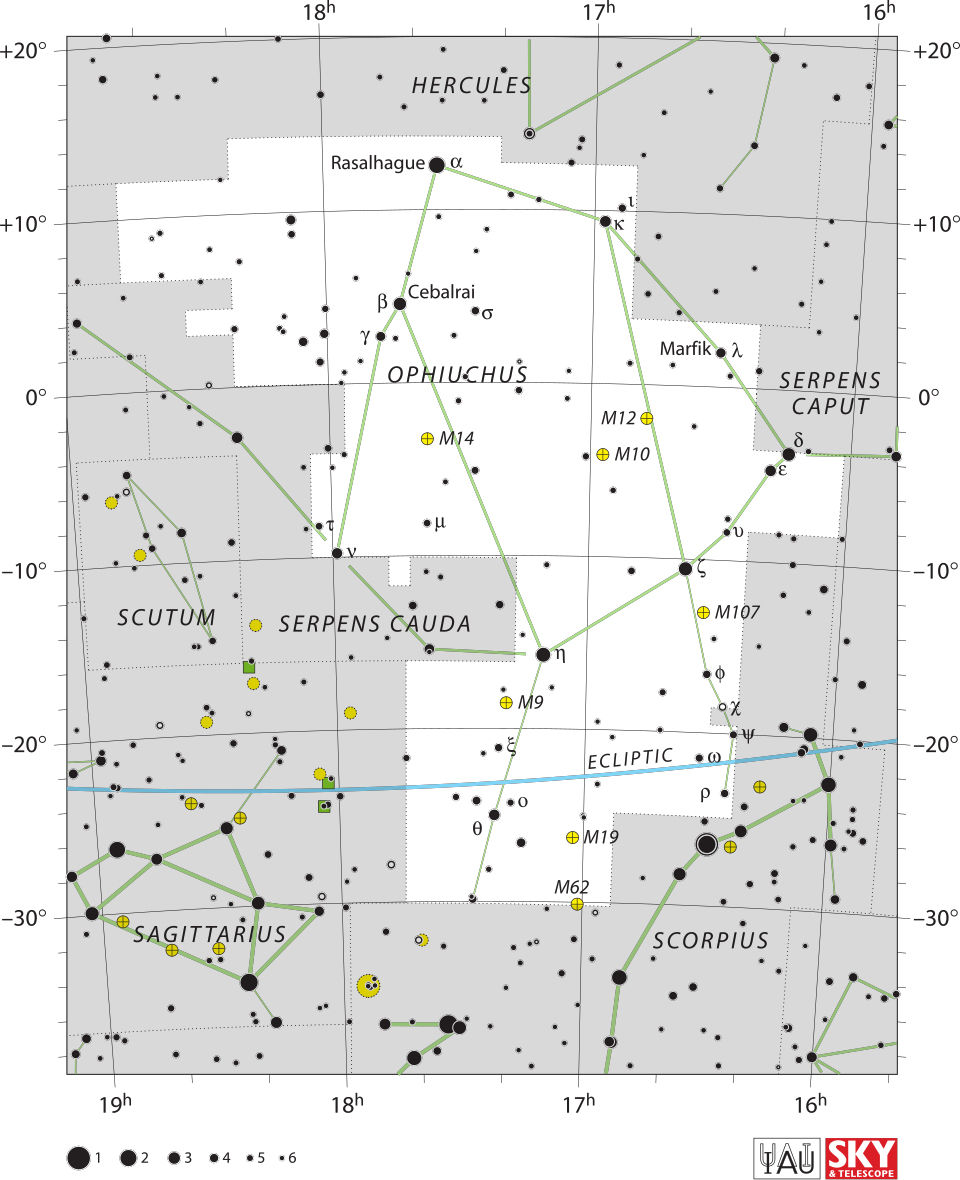
Finding Chart

Click to expand
Image Capture
Location:
Kanab, Utah
Camera:
Total integration: 15h 49m
Integration per filter:
- Lum: 3h 55m (235 × 60")
- R: 4h 3m (243 × 60")
- G: 4h (240 × 60")
- B: 3h 51m (231 × 60")
Coordinates: 16h 28m 10s · -25° 41′ 18″
ZWO ASI6200MM-Pro


Amateur Astronomy Picture of the Day

Astrobin Top Pick
Awards