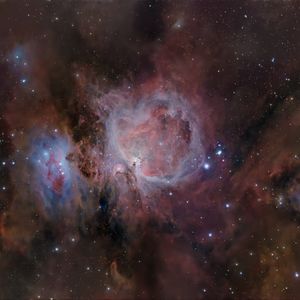
The Universe is Full of Doors - The Keyhole - NGC 1999 & vdB 46
January 5, 2026
Use mouse wheel to zoom, drag to pan, and buttons for other options
I’ve titled and classified this image as vdB 46 & NGC 1999. But there’s much more to it than that. It was a challenging project because it’s located just adjacent to the Great Orion Nebula (Messier 42), which is very bright and also surrounded by bright stars. This had a tendency to wreak havoc at the top of the frame. I couldn’t eliminate those effects entirely, but I did my best to control them.
Just below the center in the frame, you can see the main subject of the image—a bright white area catalogued as vdB 46 and NGC 1999. Colloquially, many call it the “Keyhole Nebula” because of the shape of the dark region at its center. The Keyhole is classified as a reflection nebula because its bright white and blue color is the result of light reflected from the very hot multiple star system V380 Orionis (visible just to the left of the dark “keyhole”). Scientists once thought that the keyhole shape came from dark, cold gas and dust called a Bok Globule. But more current research suggests that it may simply be a hole in the reflection material that jets from the V380 Orionis star system carved out.¹ You can zoom in on this above, but here’s a close crop to help you find it:

Just below vdB 46 you can find a fascinating region containing a strange-looking donut. At ten o’clock, on the edge of the donut, you can see a formation of lumpy red material. Another such lumpy formation appears at about one o’clock a little further away. These are Herbig-Haro (HH) objects, which are shock regions around newly forming stars that emit jets that collide with the surrounding material and light it up.
And these are not just HH objects, they are the first two to be recognized as such in the 1940s by researchers George Herbig and Guillermo Haro. The one toward the upper right is designated HH1 and the one next to the donut is designated HH 2. Oftentimes, HH objects consist of a single newly forming star. But both these objects are actually clumps, or even swarms, of such objects. The donut, however, is unusual and seems to be the product of polarized light combining with chaotic magnetic fields emanating from the clumps in HH 2:

Immediately above the Keyhole, you can find the blue combination reflection-emission nebula IC 427 and above that lies IC 428. American astronomer Williamina Fleming discovered them in 1888 (she also discovered the Horsehead Nebula). Although Edward Pickering was initially credited with discovering them, it was Fleming who first observed them:
IC 427 (top) and IC 428 (bottom)
Above that, the bright triangular area is generally the result of outflow from HH 305 and the associated star PR Orionis. Don’t be fooled by the diffraction spikes emanating from PR Ori. Those are just artifacts of the optics on the CDK12 telescope. You cannot discern the bipolar jets in this image because of the brightness of the blue-white triangular formation. But you can see distinct pink blobs above and below the triangle, which are the result of the jets colliding with the surrounding material.

To the right of PR Orionis, you can find Herbig-Haro 222, the Waterfall Nebula. Scientists think the Waterfall is a giant bow shock 10 light years long caused by the star V380 Orionis, which is just to the left of the Waterfall.

Note that this image comes in two versions: (1) a true-color, broadband version, and (2) a false-color narrowband version shot with specialized filters to reveal the structure of ionized gases present in the area. To access the false-color image, use the slideshow controls that appear in the lower right area of the image frame when you mouse over the image.
_____________________
¹ Many thanks to Dr. Adolf Witt for alerting me to the Stanke, et al, article regarding what may be the true cause of the keyhole formation


Telescope

Planewave CDK12.5
Finding Chart

Click to expand
Image Capture
Location:
Deep Sky West
Camera:
Total integration: 93h 17m
Integration per filter:
- Lum/Clear: 11h 21m (227 × 180")
- R: 8h 16m (165 × 180")
- G: 8h 9m (163 × 180")
- B: 8h 12m (164 × 180")
- Hα: 20h 0m (120 × 600")
- O3: 23h 0m (138 x 600")
- S2: 17h 20m (104 x 600")
Coordinates: 05h 36m 17.652s · -6° 37′ 37.29″
Moravian C5a-100M

Awards