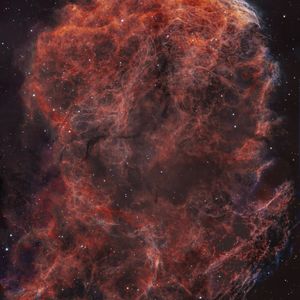
FSQ106 First Light - The Jellyfish Nebula (Sh2-248) and some Clusters (including Messier 35)
February 23, 2024
Use mouse wheel to zoom, drag to pan, and buttons for other options
The star of this show might look like it’s the Jellyfish Nebula (catalogued as IC 443 and Sh2-248) near the center at the bottom of the frame. But it’s really the open star cluster Messier 35 (M35), the Show-Buckle Cluster. The reason for that is that I needed an image of it to complete my collection of all 110 Messier objects.
Messier 35
M35 lives in the Gemini constellation—and is the sole Messier object in that constellation—about 3,000 light years away. It spans roughly 30 light years and contains around 400 stars. It’s likely somewhere north of 100 million years old.
Open star clusters (or “open clusters”) are collections of stars—perhaps a few dozen to a few thousand—that likely formed in the same molecular cloud but are not gravitationally bound to each other. They eventually wander away from each other and find their own paths through the galaxy. Our own sun was probably once part of an open cluster at one time but has since moved out on its own.

Sh2-247
Way down at the bottom of the image almost directly below M35, you can find Sh2-247. It’s a relatively small star-forming emission nebula much farther away at a distance of about 7,300 light years. Don’t let its small stature from our vantage fool you, though. It contains more than 37,000 times the mass of our sun—mostly in the form of free-floating hydrogen.

IC 443 (Sh2-248)
Just left of center, in the lower part of the frame, you can find the Jellyfish Nebula, which is an unusual supernova remnant roughly 5,000 light-years away from here.
The main leftover from that explosion appears to the be pulsar (a pulsating neutron star) creatively called CXOU J061705.3+222127. The object has an atypical shape for supernova remnants, which one study attributes to interaction of the expanding gasses from the explosion and the surrounding interstellar medium, which was already rich with material.
While there are many classifications of supernovas, the most common are Type Ia and Type II supernovas. The Jellyfish is likely an example of the aftermath of a Type II supernova.
Type II supernovas occur when a star eight times, or more, the mass of the sun runs out of hydrogen fuel and starts burning heavier elements. But rather than stopping at carbon, the gravitation created by the larger mass causes the star to continue fusing heavier and heavier elements until it gets to iron.
Unlike lower levels of fusion, fusing iron actually requires more energy than it produces. At that point equilibrium between gravity trying to crush the star and fusion trying to hold the star up is lost. The outer layers rush in toward the core at a significant percentage of the speed of light. That material smashes into the core and rebounds, producing a cataclysmic supernova explosion. The good news is that this seeds the area with heavier elements—those required to create and support life, build concert halls, and fill footballs with air.
What’s left behind is generally either a neutron star or a black hole.

Sh2-249
Sh2-249 is an emission nebula just above the Jellyfish. Although it appears to be part of the Jellyfish, scientists have conjected that it is actually a bit farther away at a distance of around 5,200 light years. But this is not conclusive and its exact relationship to the Jellyfish remains unknown.

vdB 75
Tucked up against the edge of Sh2-249, the blue reflection nebula vdB 75 resides. The latest estimates place it at a distance of approximately 5,600 light years. The bright star Gem 12 is the source of its reflective illumination.




Telescope

Takahashi FSQ106
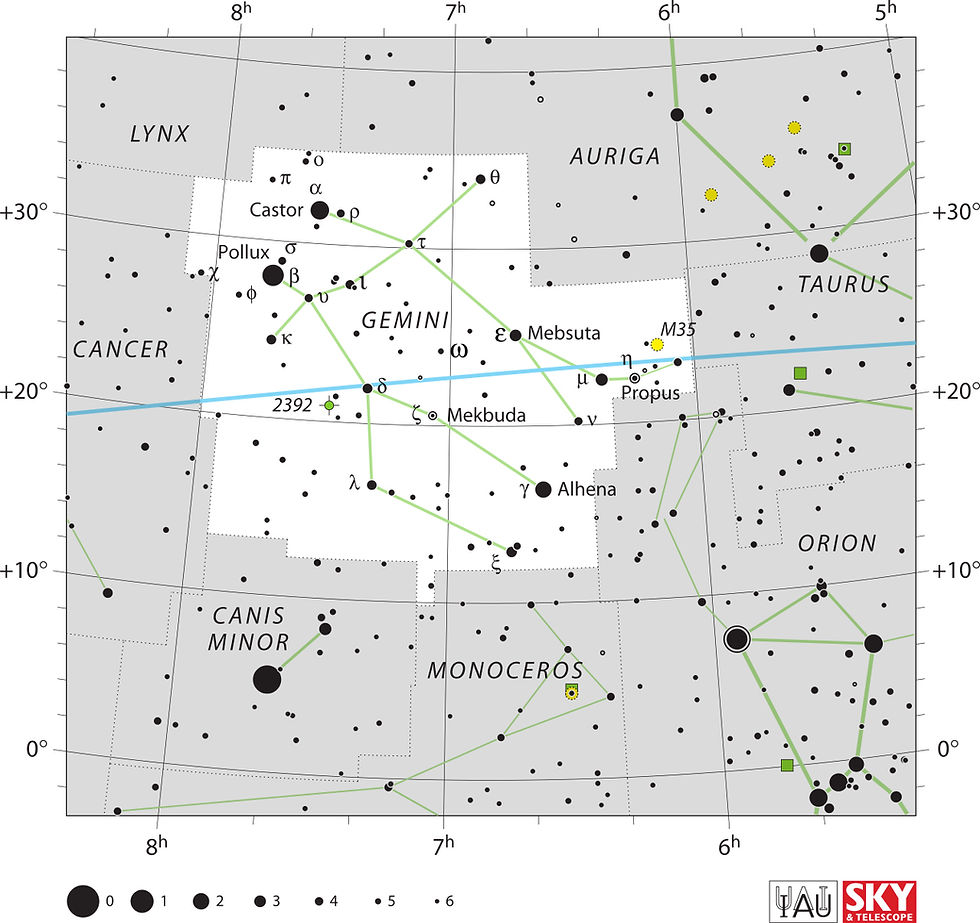
Finding Chart

Click to expand
Image Capture
Location:
Back yard in North Dallas
Camera:
Total integration: 25h 37m
Integration per filter:
- R: 1h 42m (66 × 60")
- G: 1h 42m (59 × 60")
- B: 1h 42m (55 × 60")
- Hα: 7h 51m (157 × 180")
- S2: 7h 42m (154 × 180")
- O3: 6h 54m (138 × 180")
Coordinates: 6h 15m 10s · +23° 16′ 47″
Moravian C3-61000

Awards