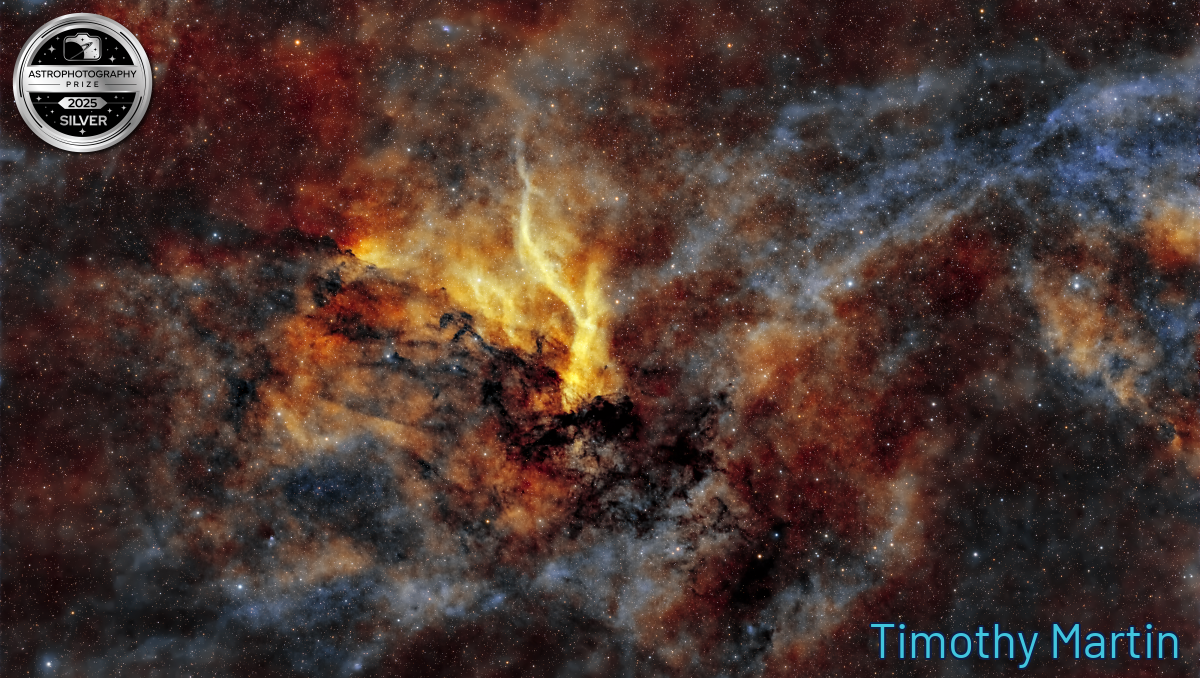
Dragon Breath – LDN 1278
September 20, 2024
Use mouse wheel to zoom, drag to pan, and buttons for other options
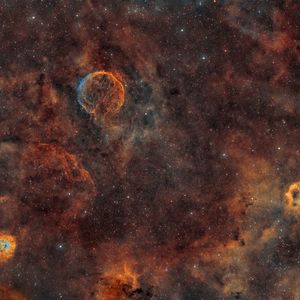
This is one of my favorite images. Not because it’s particularly beautiful. And not because it shows off any technical expertise. But because no one else has ever shot this target that I can find—at least not as the main focus of the image. I saw this in a wider field I was shooting with the small refractor and decided to go after it with the big refractor. The chemistry I uncovered is interesting. Even after spending several hours shooting for oxygen gas, I could find none. But the area is rich in ionized hydrogen and sulfur gasses.
The dark clouds that form the breath of the Dragon are ideal locations for star formation, but I can find no studies regarding star formation in this immediate area. Fodder for some poor graduate student someday, perhaps.
I’ve also had no luck finding a distance measurement for this either. But it seems, at least visually from our vantage on Earth, to be part of the Cassiopeia OB Association—a large molecular cloud that seems somewhat coherent—as Sh2-170 and Sh2-173 (not visible in this frame), which sandwich the Dragon. Sh2-170 is around 9,100 light years away and Sh2-173 is about 7,500 light years away. So that would seem to put the Dragon in the range of 7,000 to 9,000 light years.
The designation LDN 1278 comes from the Lynds’ Catalogue of Dark Nebulae (LDN). It was compiled by American astronomer Beverly Turner Lynds and published in 1962 with 1,802 entries. Dr. Lynds recently died in Portland, Oregon in October 2024 at the age of 95.
Beverly Turner Lynds leaves an amazing legacy in the world of astronomy—just as Vera Rubin, Sandra Faber, Caroline Herschel, Jocelyn Bell Burnell, and so many other women have. We stand on their tall, strong shoulders.


Telescope

Takahashi TOA130
Finding Chart

Click to expand
Image Capture
Location:
Deep Sky West
Camera:
Total integration: 77h 8m
Integration per filter:
- Lum/Clear: 9h 18m (186 × 180")
- R: 21m (21 × 60")
- G: 21m (21 × 60")
- B: 21m (21 × 60")
- Hα: 38h 35m (463 × 300")
- S2: 37h 15m (447 × 300")
Coordinates: 0h 15m 19s · +63° 54′ 1″
Moravian C5a-100M


NASA Sky
Astrophotography Prize Silver
Awards