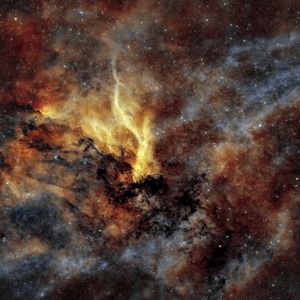
Mischief in the Theatre – The Little Rosette, Phantom of the Opera, and Popped Balloon Nebulas
November 17, 2022
Use mouse wheel to zoom, drag to pan, and buttons for other options
Just as a beautiful floral arrangement appeared for the star of the show, someone let go a balloon to careen through the opera house.
This rich field in the Cassiopeia constellation contains a number of interesting objects. Let’s go through them top to bottom, left to right. I shot this image in 2022 on a trip to Borrego Springs, California for the Nightfall star party.
CTB 1 – The Popped Balloon
Near the top of the frame just left of center, you can find the Popped Balloon Nebula—also called the Medulla Nebula or the Garlic Nebula. It’s a supernova remnant catalogued as SNR G116.9+00.1 SNR stands for “supernova remnant” (the remains of an exploded star) and the numbers represent the object’s galactic coordinates. Distance estimates range from 7,000 to 11,000 light years.
It was also listed as the first entry in a survey of galactic radio sources) in 1960 by R.W. Wilson and J.G. Bolton at the CalTech Radio Observatory. It’s commonly referred to as CalTech list b, so the object garnered the designation CTB 1.
To make things a bit more confusing—quite a bit more—George O. Abell added it to his list of planetary nebulas in 1966 as the 85th of 86 entries, hence it also has the designation Abell 85. He even noted that it was likely a supernova remnant and not a planetary nebula. It’s one of four entries in that catalogue of planetary nebulas that aren’t planetary nebulas. To make matters worse, Abell had previously published a list of 4,073 galaxy clusters in 1958. Both carry the Abell name, so there are two Abell 85s that are radically different objects.
CTB 1 had been thought to be around 16,700 years old, but more recent estimates place its age closer to 10,000 years. This would make it around 50 light years in diameter.

Sh2-170 – The Little Rosette
Near the lower-left corner of the image, you can find Sh2-170, sometimes called “The Little Rosette Nebula.” It’s an emission region of ionized gasses that give off their own light approximately 6,500 light years from Earth. Extreme radiation from the star at the center of the nebula has eroded the gas from that region and created a circular outflow that makes the nebula look like a small rosette-type formation. The colloquial name gets the “little” adjective because of the much larger Rosette Nebula (Caldwell 49) in the Monoceros constellation.

LDN 1278 – Dragon Breath
LDN 1278 is the dark nebula and surrounding area at the bottom-center of the frame. Taking this image inspired me to use one of my larger telescopes to get a much closer look at that. Refer to that image for much more information on this intriguing formation.

Sh2-172
The tiny Sh2-172 can be seen at the right-center of the image. Don’t blink or you’ll miss it. I could find no solid distance measurement for the small Sh2-172 emission nebula, but a 2007 paper speculates that it’s about 10,000 light years away.

Sh2-173 – The Phantom of the Opera
Below Sh2-172 in the lower-right area of the image, you can find Sh2-173, the Phantom of the Opera Nebula. Like Sh2-172, its distance is thought to be around 10,000 light years.


Telescope

William Optics ZenithStar 61
Finding Chart

Click to expand
Image Capture
Location:
Borrego Springs, California
Camera:
Total integration: 32h 48m
Integration per filter:
- R: 15m (30 × 30")
- G: 15m (30 × 30")
- B: 15m (30 × 30")
- Hα: 14h 39m (293 × 180")
- S2: 7h 30m (150 × 180")
- O3: 9h 54m (198 × 180")
Coordinates: 0h 7m 2s · +62° 35′ 33″
ZWO ASI6200MM-Pro

Awards