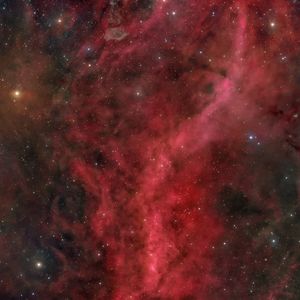
The Boogeyman Nebula – LDN 1622
November 15, 2023
Use mouse wheel to zoom, drag to pan, and buttons for other options
The designation LDN 1622 for the Boogeyman Nebula comes from the Lynds’ Catalogue of Dark Nebulae (LDN). It was compiled by American astronomer Beverly Turner Lynds and published in 1962 with 1,802 entries. Dr. Lynds recently died in Portland, Oregon in October 2024 at the age of 95. Dark nebulas (also called absorption nebulas) are dense regions of molecular gas and dust that blocks light from passing though them. This gives them an inky black appearance.
LDN 1622 – The Boogeyman Nebula
The Boogeyman is located in the Orion constellation about 500 light years from our solar system. To us, it appears to float in a sea of red, ionized hydrogen gas just next to a huge formation called Barnard’s Loop (not pictured), which is probably closer to 1,400 light years away.
I’ve found that some people have trouble picking out the form of the Boogeyman in images of LDN 1622, so I isolated the emissions from ionized hydrogen and created this black-and-white rendering that may make him easier to see:

vdB 62
In the color image, just above the Boogeyman’s left shoulder, you can see the smaller, but intricate, reflection nebula vdB 62. To me, it looks like the opening to a cosmic lighthouse. I can find no solid distance estimates for it or its ostensible illuminating star, HD 288313. But given that the distance estimates for other objects in the image are between 500 and 1,400 light years, it seems reasonable to assume that vdB 62 is somewhere in that range.
vdB 63
Another reflection nebula, vdB 63, is located below the Boogeyman. Again, I can find no reliable distance estimate for this object, so I would apply the same logic to it as with vdB 62.

PN-G 205.4-11.7
Off to the right (south), you can see PN-G 205.4-11.7 (“PN” denotes that the object is thought to be a planetary nebula, while the “G” indicates that the location that follows is given in galactic coordinates). It was once thought to be a planetary nebula but has since been classified as a cometary globule. Cometary globules are generally compact and dark pockets of interstellar gas and dust that often have tail-like structures.


Telescope

Takahashi TOA130
Finding Chart

Click to expand
Image Capture
Location:
Deep Sky West
Camera:
Total integration: 21h 49m
Integration per filter:
- Lum: 5h 39m (113 × 180")
- R: 3h 48m (76 × 180")
- G: 3h 36m (72 × 180")
- B: 3h 36m (72 × 180")
- Hα: 5h 10m (62 × 300")
Coordinates: 5h 55m 26s · +1° 52′ 4″
Moravian C5a-100M


Amateur Astronomy Picture of the Day

NASA Sky

Astrobin Top Pick Nomination
Awards