Messier 46 and Messier 47 in a Dusty Region
January 6, 2025
Use mouse wheel to zoom, drag to pan, and buttons for other options
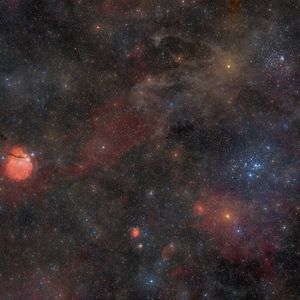
Molecular clouds, dust, and emission clouds surround Messier 46 (M46) and Messier 47 (M47) in this image. Only through long-exposure photography do these features become apparent. It reveals a story in and around these open clusters that is far more intriguing than merely a field of stars on a black background.
Messier 46, NGC 2438, the Calabash Nebula, and Minchinkov 1-18
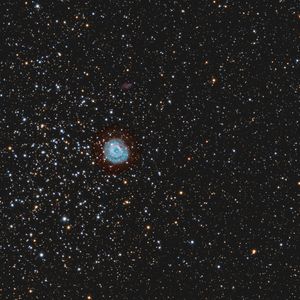
M46 is notable because of its nearby planetary nebulas. I’ve previously posted a closer view taken with a larger telescope.
M46 is an open star cluster in the Puppis constellation approximately 5,400 light years away. Open star clusters (or “open clusters”) are collections of stars—perhaps a few dozen to a few thousand—that likely formed in the same molecular cloud, but are not gravitationally bound to each other. They eventually wander away from each other and find their own paths through the galaxy. Our own sun was probably once part of an open cluster at one time but has since moved out on its own.
M46 appears to contain around 500 stars, likely has an age of around 300 million years, and occupies a space of roughly 30 light years in breadth.
What makes M46 particularly interesting is the presence of planetary nebulas that are within the capabilities of conventional earthbound telescopes to observe. The name “planetary nebula” is a misnomer. Planetary nebulas have nothing to do with planets. Astronomers in the 18th century thought these objects were planets, but now we know differently. When a star with 80% to 800% of the sun’s mass begins to run out of hydrogen fuel, it starts fusing helium into heavier elements such as carbon and oxygen. As it does this, the additional energy from those stepped-up levels of fusion cause it to expel its outer layers.
Ultimately, the star expels all its outer layers from its core, leaving the core exposed in sort of a cosmic burp. Once all the helium is burned up, fusion ceases in the core and what is left is a giant, dense ball of carbon (about the size of the earth, but with the mass of the sun)—a diamond in the sky called a “white dwarf.” That core no longer produces new energy, but it’s still extremely hot and gives off copious amounts of radiation, ionizing the gas it expelled earlier. That cloud of gas then eventually dissipates. But before it does, the ionized gas gives off light we can record here on earth with our cameras (if the star is close enough to us).
The most obvious of these planetary nebulas is NGC 2438, which appears along the edge of the cluster. Although it appears as though it’s part of the M46 cluster, it’s not. It’s actually about 2,500 light years closer. It started forming a little over 4,000 years ago. What’s left of its progenitor star is a tiny white dwarf (visible at the center of the nebula in the image) with an astonishing surface temperature of around 75,000 degrees Kelvin.
To the right of NGC 2438, you can see a tiny red smudge. This misshapen blobs is called the Calabash Nebula, so named for the calabash gourd. The Calabash Nebula represents the early phase of the formation of a planetary nebula—a protoplanetary nebula.
This is a pretty rare thing to find because planetary nebulas form so quickly compared to typical astronomical timescales. This makes them a bit like cats—you know they’re doing it, you just can’t catch them at it. Scientists think the Calabash Nebula is actually part of the M46 cluster because it measures to roughly the same distance and shares the same proper motion (its perceived path across the sky from our point of view). The Calabash Nebula’s presence in the cluster would seem to contradict its age estimate of 300 million years because it generally takes a billion years or more for a planetary nebula to begin forming from a sun-like star.
Finally, below M46, you can find the tiny planetary nebula Minchinkov 1-18 (PK231+4.1).

Messier 47 – The Missing Cluster
M47 is another open cluster in Puppis. It’s about 1,600 light years from Earth, is about 12 light years across, contains about 50 stars, and is an estimated 78 million years old.
For hundreds of years, no one knew where M47 was. Messier made a sign error when he recorded its position, so its whereabouts became a centuries-long mystery. In 1959, T.F. Morris, an astronomer at the Montreal Centre, solved the puzzle and M47 was, at last, found.


Telescope

Takahashi TOA130
Finding Chart

Click to expand
Image Capture
Location:
Deep Sky West
Camera:
Total integration: 55h 3m
Integration per filter:
- Lum: 10h 3m (201 × 180")
- R: 7h 45m (155 × 180")
- G: 7h 39m (153 × 180")
- B: 7h 36m (152 × 180")
- Hα: 11h (132 × 300")
- O3: 11h (132 × 300")
Coordinates: 7h 38m 18s · -14° 31′ 27″
Moravian C5a-100M

Awards