Melotte 15
February 16, 2026
Use mouse wheel to zoom, drag to pan, and buttons for other options
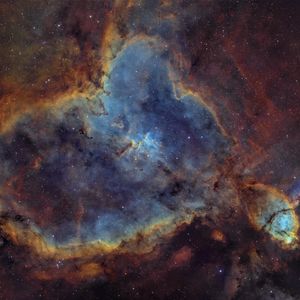
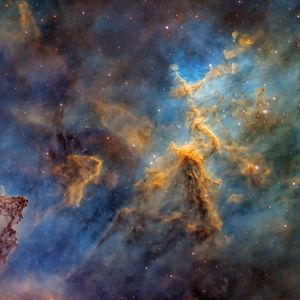
To me, this is one of the most beautiful areas in the night sky, rivaling Rho Ophiuchi. Tucked away in the center of the Heart Nebula (IC 1805 or Sh2-190) 7,500 light years away in Cassiopeia lies this incredible field of high-mass stars and flowing gaseous textures. Although astronomers typically refer to what you see here as Melotte 15, that catalogue designation actually refers to the young cluster of giant stars at its center. These stars, generally less than 15 million years old, have sculpted the gas formations into this rich field.
If Messier 31, the Andromeda Galaxy, is the Stairway to Heaven of amateur astronomy, Melotte 15 is the Don’t Stop Believin’. Just about every amateur astrophotographer on earth has shot this region. I’m no different, having gone after it at least five times now with four different telescopes.
The designation comes from the catalogue of 245 open star clusters compiled by English astronomer Philibert Jacques Melotte and released in 1915. He put together this catalogue from photographic plates of the entire sky: the Franklin-Adams Chart Plates. Between 1903 and 1910, English amateur astronomer John Franklin-Adams shot some 215 plates at the Cape Observatory in Johannesburg and from his home observatory in England using a 10” refractor. Melotte later used the plates to identify open star clusters.
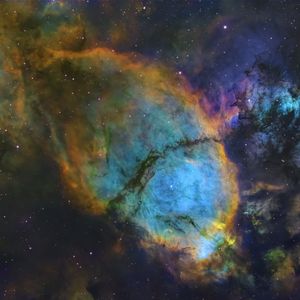
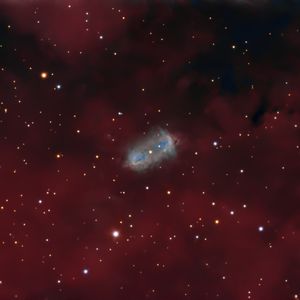
As is generally the case with photographs of emission nebulas, this is a false-color image shot with filters that isolate narrow ranges of light emitted by ionized hydrogen, sulfur, and oxygen. Using a color palette first developed by the Hubble Space Telescope team in the 1990s, the “Hubble palette,” sulfur is assigned to red, hydrogen is assigned to green, and oxygen is assigned to blue. This helps reveal the mixture of these gases in the nebula. Where sulfur and hydrogen mix, you’ll see gold or brown shades. Where oxygen and hydrogen mix, you’ll see varying shades of blue, teal, and green. And where sulfur and oxygen mix, you can see shades of magenta or purple.


Telescope

Takahashi TOA130
Finding Chart

Click to expand
Image Capture
Location:
Deep Sky West
Camera:
Total integration: 79h 30m
Integration per filter:
- R: 30m (30 × 60")
- G: 30m (30 × 60")
- B: 30m (30 × 60")
- Hα: 26h (156 × 600")
- SII: 26h (156 × 600”)
- OIII: 26h (156 × 600”)
Coordinates: 2h 33m 42.763s · +61° 24′ 26.9″
Moravian C5a-100M


Astrobin Top Pick
Awards