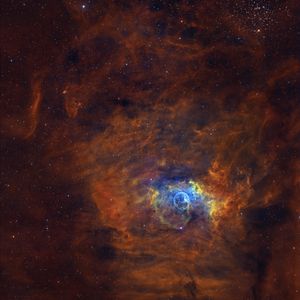
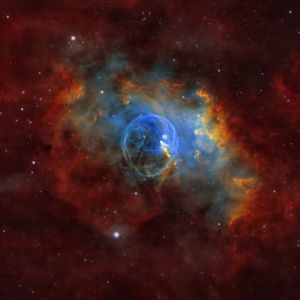
NGC 7635 – Bubble Nebula in the Hubble Palette
November 16, 2021
Use mouse wheel to zoom, drag to pan, and buttons for other options
The Bubble Nebula is one of the most intriguing objects in the sky. Seven light years across, it’s powered by a star 45 times more massive than the sun. For those keeping score at home, it’s the Wolf-Rayet star BD +60°2522. The energy it produces slams into the interstellar gas around it at four-million miles per hour, creating the bubble effect.
The Bubble is about 7,100 light years away from Earth. In four to ten million years, the off-center star energizing it will blow itself apart in a Type II supernova explosion.
As a fun exercise, I cropped and rotated the image to match the 26th Anniversary Hubble Space Telescope image of the Bubble. You can compare my effort below (on the left), with the Hubble image (right). Note that my image cost just a bit less than the $16 billion the Hubble Space Telescope has cost American taxpayers to date.
Note that I processed this image in a very similar way to how the Hubble team processes its images. Light from sulfur gas is assigned to red, light from hydrogen gas is assigned to green, and light from oxygen gas is assigned to blue—the same order the emissions from these gasses appear in the spectrum. This is called the “Hubble Palette.”
See below for a link to an image relying on the same data, but processed in the Foraxx palette—a dynamic color palette developed by astrophotographers for astrophotographers to help expose more of the chemistry going on in objects like this.


Telescope

Celestron 1100 EdgeHD
Finding Chart

Click to expand
Image Capture
Location:
Back yard in North Dallas
Camera:
Total integration time: 21h 30m
Integration per filter:
- Hα: 7h 30m (150 × 180")
- S2: 6h 51m (137 × 180")
- O3: 7h 9m (143 × 180")
Coordinates: 23h 20m 49s · +61° 12′ 30″
ZWO ASI6200MM-Pro

Awards