Fyunch(click)! M38 and the Gripping Hand (LBN 794)
January 6, 2024
Use mouse wheel to zoom, drag to pan, and buttons for other options
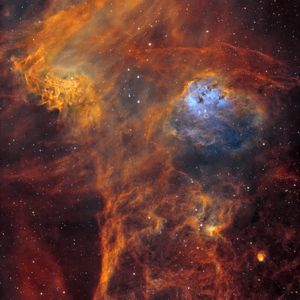
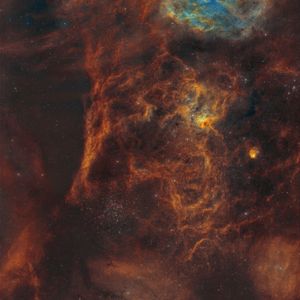
The open star cluster Messier 38 (M38) is surrounded by a faint, intriguing emission region catalogued as LBN 794. I tried to choose a framing that would showcase both of these regions and provide more context for M38.
Messier 38 – The Starfish Cluster
M38 is visible in the left-center of the frame. It’s a fairly typical, nondescript, “boring” open star cluster in the Auriga constellation and it resides about 4,200 light years from Earth. The common name, Starfish Cluster, is a result of some people seeing the shape of a starfish in the stellar arrangement, but that is totally lost on me. I don’t see it.
Open star clusters (or “open clusters”) are collections of stars—perhaps a few dozen to a few thousand—that likely formed in the same molecular cloud but are not gravitationally bound to each other. They eventually wander away from each other and find their own paths through the galaxy. Our own sun was probably once part of an open cluster at one time but has since moved out on its own.
LBN 794 – The Gripping Hand
The Gripping Hand is the name I personally give to the emission formation to the right of M38. I can only speculate on its distance, which I guess to be about 10,000 light years away based on the distance to other adjacent nebulas.
Anyone who has read The Mote in God's Eye by Larry Niven and Jerry Pournelle will get the title reference. And if you haven't read it, I envy you. I’d love to be able to read it again for the first time. It’s one of my favorite SF novels. It refers to the alien “Moties,” who have two smaller, nimble arms and one larger arm sporting a much stronger “gripping” hand.




Telescope

Takahashi TOA130 - Deep Sky West
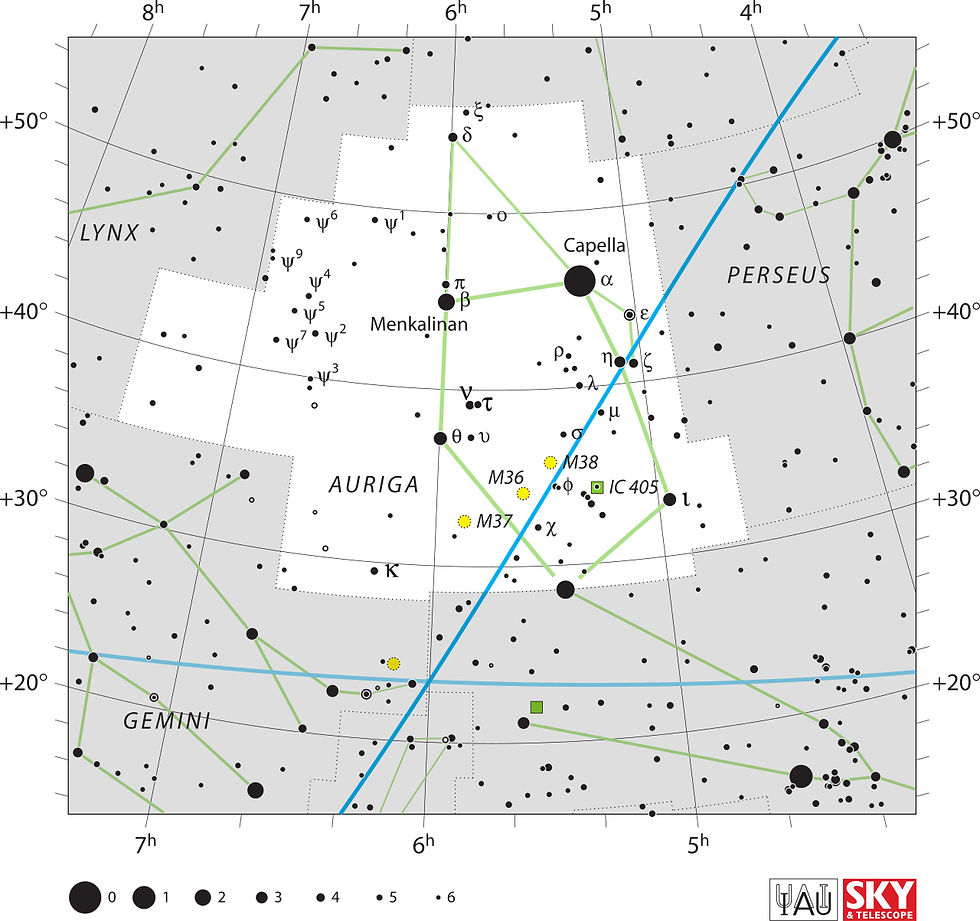
Finding Chart

Click to expand
Image Capture
Location:
Deep Sky West
Camera:
Total integration: 20h
Integration per filter:
- R: 25m (25 × 60")
- G: 25m (25 × 60")
- B: 25m (25 × 60")
- Hα: 9h 40m (116 × 300")
- S2: 9h 5m (109 × 300")
Coordinates: 5h 25m 46s · +35° 31′ 10″
Moravian C5a-100M

Awards