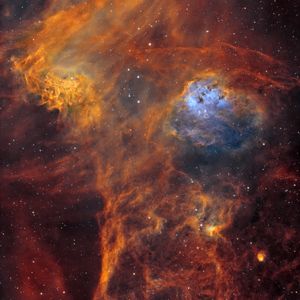
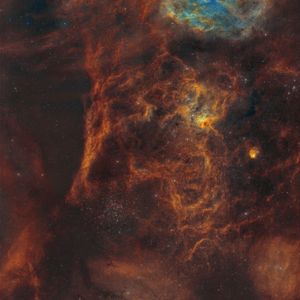
Messier 36 (M36) - The Pinwheel Cluster with the Spider and the Fly
December 26, 2024
Use mouse wheel to zoom, drag to pan, and buttons for other options
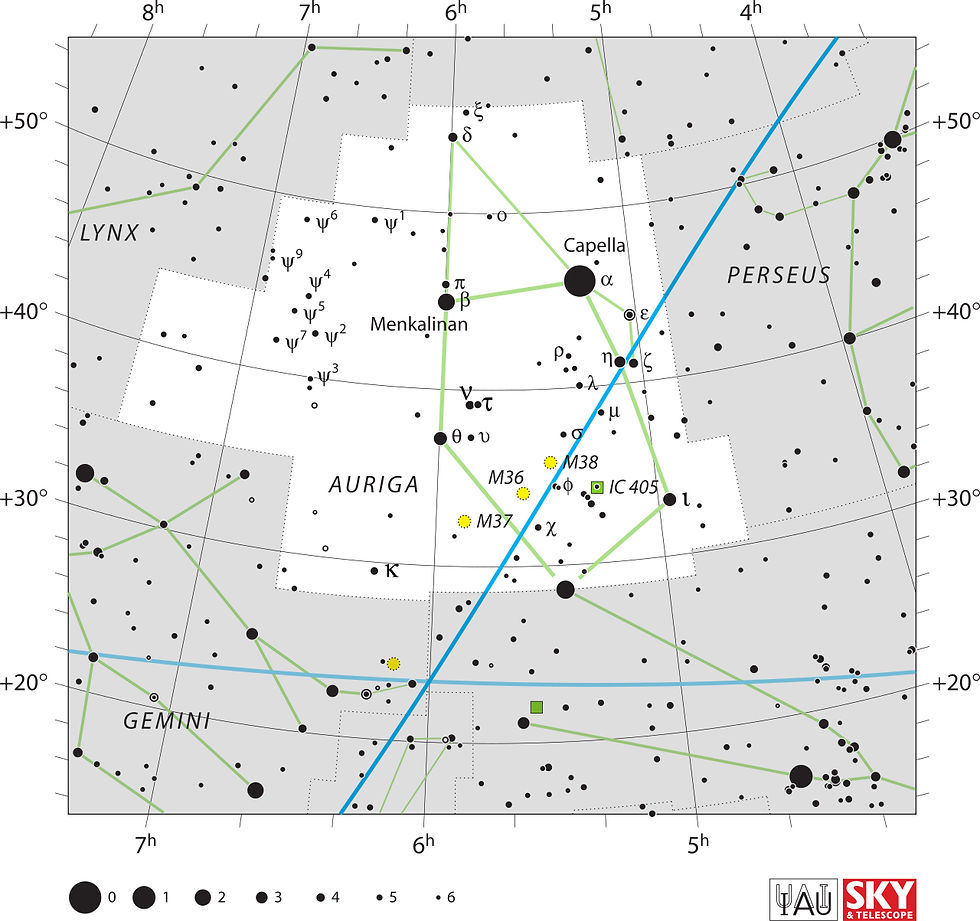
Messier 36 (M36) is an open star cluster in the Auriga constellation roughly 4,300 light years from our solar system. N36 is about 14 light years in diameter and contains about 60 stars.
Open star clusters (or “open clusters”) are collections of stars—perhaps a few dozen to a few thousand—that likely formed in the same molecular cloud but are not gravitationally bound to each other. They eventually wander away from each other and find their own paths through the galaxy. Our own sun was probably once part of an open cluster at one time but has since moved out on its own.

One interesting thing about M36 is that in 1993, astronomers at Kitt Peak Observatory in Arizona discovered a young stellar object inside it—specifically an object called a T Tauri star that is not quite yet really a star, but is becoming one. The official catalogue entry is IRAS 05327+3404, but its discoverers gave it the name Holoea (Hawaiian for “flowing gas.”). Holoea exhibits an outflow, which is typical of young stellar objects like it.

Known as the Fly Nebula, NGC 1931 (at the center of the image) is another star cluster buried in a small nebulous formation, Sh2-237. It’s companion, and sworn enemy, the Spider Nebula, IC 417 and Sh2-234 (toward the upper right), lies close by, ready to entangle it. The Fly is about 7,000 light years from us while the Spider has some ground to cover at 10,000 light years away.
L to R: NGC 1931 (Sh2-237), the Fly, and IC 417 (Sh2-234), the Spider




Telescope

Takahashi TOA130
Finding Chart

Click to expand
Image Capture
Location:
Deep Sky West
Camera:
Total integration: 20h 9m
Integration per filter:
- R: 1h 39m (99 × 180")
- G: 1h 37m (97 × 180")
- B: 1h 38m (98 × 180")
- Hα: 7h 50m (94 × 300")
- O3: 7h 29m (89 × 300")
Coordinates: 5h 31m 49s · +34° 18′ 55″
Moravian C5a-100M


Astrophotography Prize Silver
Awards